
On God’s path in Goa
Ruminations on religious structures across time, space, and denominations
Admin User
Author
Published
March 5, 2026
When someone plans a trip to Goa, finding a moment to commune with God is usually not high on anyone’s agenda. And yet, over the course of a few memorable days in late January, 2026, that is exactly what I found myself doing. Well, at least meeting people who were seeking God, in all the right places.
The Mahadev Temple in the village of Tambdi Surla is well off the beaten track and out of sight for most tourists. The temple is within the Mahaveer wild-life sanctuary, and is approached by crossing a picturesque little stream.
The temple dates back to the 13th century, and is dedicated to Lord Shiva. It is made of chloritic schist which, being a soft stone, lends itself easily to being sculpted. It features lathe-turned pillars, lattice screen windows and a Nagara-style spire.
A group of school kids about eight-to-ten years old was visiting along with their teachers who were making every effort to keep the students in line, while ensuring each of them got an opportunity to pay respects and view the temple.
I meet Uttam Kumar from ASI, a young man on his first job, assigned just a couple of months ago to this site. We discuss the similarities this temple bears to temples from the Hoyasala and Chalukya styles, especially the ones from Halebidu, although it is much smaller in size and modest in ambition.
I move on to the Mahalakshmi temple, reaching it just in time for their mid-day prayers. A man stood outside, holding a mirror mounted on a stand, reflecting the sun’s rays directly on to the idol in the sanctum sanctorum. One of the volunteers had the job of shooing away devotees from the path of the light. Unusually in my experience, the seating space in the sabha mandapam was segregated into men’s and women’s sections. A group of volunteers go about distributing prasad — one comes with a chunk of guava, another with a piece of banana, another with a few crumbs of laddu and a fourth with sprouts. You are supposed to hold on to the banana peel until the signal is given that the congregation may rise. There are a couple of bins placed in the middle of the hall dividing the men’s section and the women’s, for the purpose of disposing of the peels. Again, unusual in my experience.
The Mahalakshmi temple — A man adjusts a mirror to make sure the sun light falls directly on the idol inside (left) and the interior hall with grand chandeliers (right)
The Mahalakshmi temple has a grand chandelier in the sabha mandapam and a richly decorated interior with murals and iconographic idols. There is an outer chamber, somewhat akin to a natya mandapam, with a feature upstairs resembling a choir loft of a church.
I then visited in quick succession a number of other temples in the vicinity — the Mahalasa temple, the Shantadurga temple, Ramanathi temple, the Nageshi temple, a Ganesha temple, and the Mangeshi temple.
The Magha festival was being celebrated at the Shantadurga temple, with lots of stalls and vendors and wares of all kinds from food stuffs to clothes to arts and handicrafts. The idol here features Durga in an unusual seated position, with her feet stretched in front of her.
All of the temples have a similar outer structure, with a flat-roofed natya mandapam and sabha mandapam, followed axially by an antarala and the garbha griha, with a domed spire over the grabha griha. Most of these had grand chandeliers in the sabha mandapam, and all of them had segregated seating for men and women. All of them had a multi-storied deep stambh, which is NOT axially aligned with the rest of the temple. All of them were in good physical state, being well maintained.
The Ramnathi temple with a deep stambh in front, and the domed spire above the sanctum.
The Ganesha temple was the most rundown of the lot. It is also smaller than the others I visited. An appeal for renovation funds was featured at this temple as it had been at practically all the other temples, but it appears to have fallen on deaf ears so far. There is a beautiful floor painting in the sabha mandapam featuring Shiva and Parvati.
There are civil works going on at the Nageshi temple, indicating that the funds raised are actually in use.
The Mangeshi temple is the largest and best kept of the lot, deriving much of its fame and popularity from the most famous export of the village — Lata Mangeshkar. It stands on Pandit Dinanath Mangeshkar Street.
Lunch was a quick and cheap affair at the Ramanathi temple.
Then we head to Old Goa.
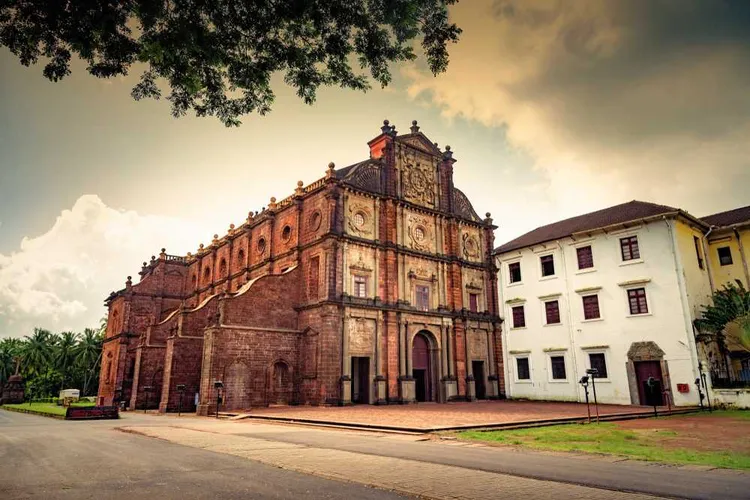
The Basilica of Bom Jesus is a grand old structure with its rugged granite looks and basalt pillars. The imposing façade is four stories high and an eclectic mix of Roman, Ionic, Doric, Corinthian, and Composite architectural styles. The church is over four hundred years, with some parts of the complex being even older. The pews inside are cordoned off to the public. A sermon is in progress — the story of Jesus drinking water from the Samaritan lady — and I want to stay and listen, but I am shooed away. There are only a handful of devotees sitting and listening, one or two lost in their Bible.
The gilded altar bears the statue of St. Ignatius of Loyola standing between Solomonic pillars, holding the infant Jesus. The building also includes the mausoleum of St. Francis Xavier, a courtyard, a belfry, and an art gallery. Unfortunately for me, the art gallery is closed by the time I have finished exploring the rest of the basilica. I rush across the street to the Se Cathedral, but that is closed as well, as is the church of St. Francis of Assissi. While grand in their own way, the pristine white-washed buildings evoke more reverence than awe.
I head out further west, pausing at the famous ruined silhouette of St. Augustine’s tower before taking the fork up the short hill to the Church of our Lady of the Rosary. Built in late Manueline style, it is probably the oldest church in Goa. It stands atop a small hill overlooking the Mandovi river and the harbour below. It is said that the Portuguese nobleman Afonso de Albuquerque ordered a small chapel to be built in honor of Our Lady of the Rosary on the spot where he was standing, when he had received the confirmation that his soldiers had completed the Portuguese conquest of Goa in 1510. It is older than the basilica that I had just visited. it has mainly Renaissance style construction and architectural elements. It is also in a much more rundown state and is sparsely decorated. There are no seats in the pews. The altar is a much simpler affair, and the chapels even simpler. There are traces of decorative elements on the walls which hint at the greater glory that the church enjoyed in the past. There is no visitor or devotee around at this time. The sun is setting and I indulge myself seated on one of the park benches outside, taking in the mellow atmosphere, until I am ushered out as it was already closing time.
I have little hope that St. Augustine’s will be open for a visit, but I am pleasantly surprised it is. The much-photographed visible fragment is that of the tower that stood in front of the church, but there is much more to the complex than this. The original facade was flanked by two huge towers of five floors, and the domestic side was a single nave with side chapels and transept. All that remains today are walls and roofless chambers of the convent, along with hints of tiled decorations of the several chapels that were part of the church originally.
The sun is now setting on the day. There were moments during the day when I felt a brush with something divine, but that feeling has long left me and all I am left with is a feeling of awe and wonderment at these magnificent houses of God, and a strong impression of less than reverential behaviour of all those who have come more to gawk than to pray.