
General4 min read
Soaring to the Sun
In ancient Indian texts, there were three places designated for the worship of the Sun god – one for the rising Sun, one for the mid-day Sun, and one for the setting Sun. These three locations have be
K
kvijaykumar
Author
Published
January 6, 2024
In ancient Indian texts, there were three places designated for the worship of the Sun god – one for the rising Sun, one for the mid-day Sun, and one for the setting Sun. These three locations have been understood to be, respectively, Konark in Odisha near the mouth of the Chandrabhaga river (which has since shifted course), Kalpi in Uttar Pradesh on the right bank of the Yamuna, and Multan, in modern day Pakistan on the left bank of the Chenab.
The Sun Temple at Konark was built during the reign of King Narasimhadeva around 1250 AD. It was built in the shape of a gigantic chariot with 24 carved stone wheels, pillars and walls and drawn by seven enormous carved horses. It was built in the traditional Kalinga style with a bhogmandir, a jagmohana, and the main deul. There are huge statues of the Sun God in various forms decorating the niches on the outer walls of the temple. The temple was known as the Black Pagoda by European sea-farers, contrasting it with the White Pagoda which was the Jagannath Temple at Puri. These two temples were used for navigating the east coast.
The splendor of the Sun Temple in Konark is mentioned in Abul Fazal’s Ain-i-Akbari from the 1580s.
When King Narasingha Deva visited the temple in 1628, the Kalasha and the Dhwajapadma were missing from the top though the temple was still standing. The legendary magnetic finial (chumbak loha dharana) was still in position, projecting above the temple, as was the idol of Suryanarayana in the temple, although the temple was in a state of disrepair. He carried the idol with him to the Puri temple.
An entry found in the 1676 diary of Sir Streynsham Master, Governor of Fort St. George, Madras, in connection with a voyage in the Bay of Bengal from Balasore Road to Masulipatnam refers to the Konark Temple. On December 23, 1676, Master saw the Konark temple and the Jagannatha temple and recoded it in his diary.
Alfred Bond, the Master Attendant at Balasore visited Konark on February 8, 1839. In his report he says, “The Black Pagoda is inland from the sea about 1 ½ miles, and there remains of this ruin the eastern temple only, the western temple having nearly all fallen down, the only portion of it still remaining being a portion of a buttress about six feet in diameter and standing about 10 feet, above the eastern Temple, and this portion appears likely to fall on the eastern temple”.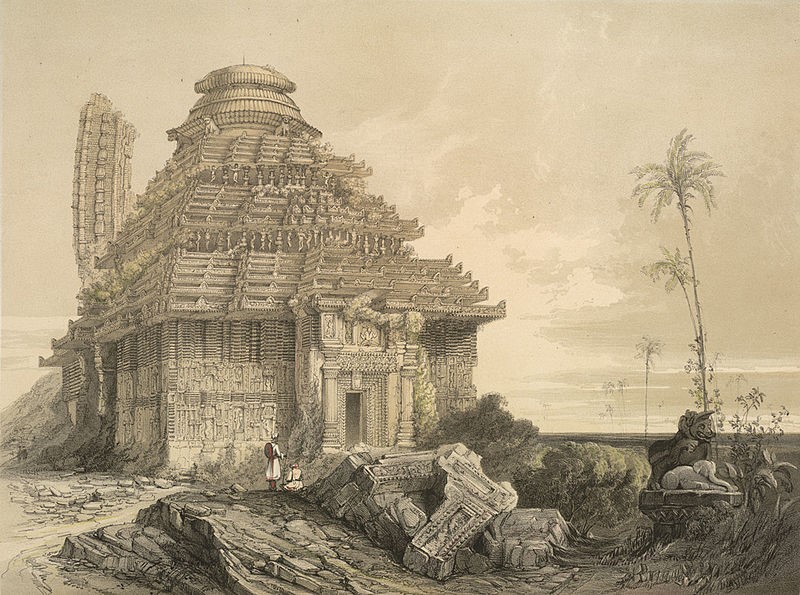
A lithography plate from James Fergusson's 'Ancient Architecture in Hindoostan' (1847) shows part of the main tower still standing. Ferguson writes that “only one fragment, one angle remains, rising to a height of about 140 to 150 feet.” This and other calculations indicate that the main temple once rose to a height of 225 feet.
In October 1848, a terrible gale brought down the remaining fragment of the main temple.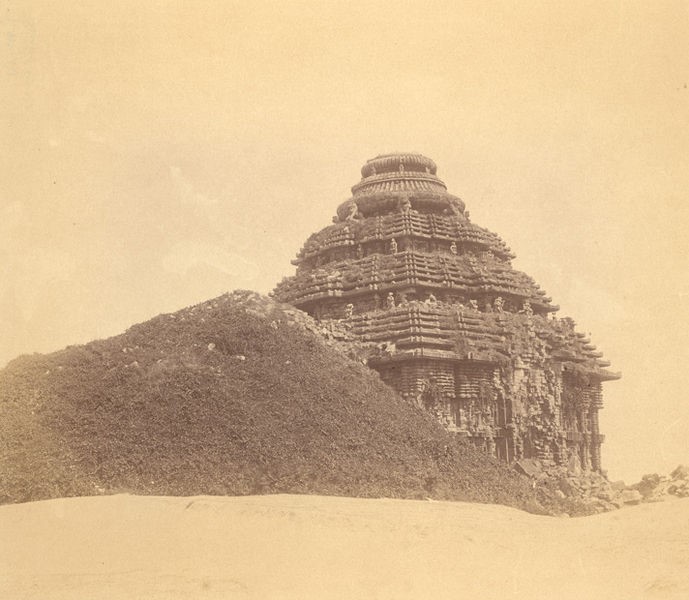
There is no trace of the main temple in the photograph from the south-west of the mandapa of the Surya Temple or Black Pagoda at Konarka, taken by William Henry Cornish in c. 1890, with large mounds and sand dunes encroaching upon the temple.
In 1893, Babu P.C. Mukherjee was deputed to Konark to take detailed drawings of the temple and he perceived that the entire plinth of the temple was buried beneath the sand.
The great Sun Temple at Konark is now in ruins. All the conservation and repair work that has gone into the temple has not been able to restore it to its former glory. Yet, even today people continue to celebrate Magha Sapatami on the Chandrabhaga beach and then visit the temple, reminding us of how the temple existed as a place of worship and reverence, about eight hundred years ago.
The Sun Temple at Konark was built during the reign of King Narasimhadeva around 1250 AD. It was built in the shape of a gigantic chariot with 24 carved stone wheels, pillars and walls and drawn by seven enormous carved horses. It was built in the traditional Kalinga style with a bhogmandir, a jagmohana, and the main deul. There are huge statues of the Sun God in various forms decorating the niches on the outer walls of the temple. The temple was known as the Black Pagoda by European sea-farers, contrasting it with the White Pagoda which was the Jagannath Temple at Puri. These two temples were used for navigating the east coast.
The splendor of the Sun Temple in Konark is mentioned in Abul Fazal’s Ain-i-Akbari from the 1580s.
When King Narasingha Deva visited the temple in 1628, the Kalasha and the Dhwajapadma were missing from the top though the temple was still standing. The legendary magnetic finial (chumbak loha dharana) was still in position, projecting above the temple, as was the idol of Suryanarayana in the temple, although the temple was in a state of disrepair. He carried the idol with him to the Puri temple.
An entry found in the 1676 diary of Sir Streynsham Master, Governor of Fort St. George, Madras, in connection with a voyage in the Bay of Bengal from Balasore Road to Masulipatnam refers to the Konark Temple. On December 23, 1676, Master saw the Konark temple and the Jagannatha temple and recoded it in his diary.
Alfred Bond, the Master Attendant at Balasore visited Konark on February 8, 1839. In his report he says, “The Black Pagoda is inland from the sea about 1 ½ miles, and there remains of this ruin the eastern temple only, the western temple having nearly all fallen down, the only portion of it still remaining being a portion of a buttress about six feet in diameter and standing about 10 feet, above the eastern Temple, and this portion appears likely to fall on the eastern temple”.
A lithography plate from James Fergusson's 'Ancient Architecture in Hindoostan' (1847) shows part of the main tower still standing. Ferguson writes that “only one fragment, one angle remains, rising to a height of about 140 to 150 feet.” This and other calculations indicate that the main temple once rose to a height of 225 feet.
In October 1848, a terrible gale brought down the remaining fragment of the main temple.
There is no trace of the main temple in the photograph from the south-west of the mandapa of the Surya Temple or Black Pagoda at Konarka, taken by William Henry Cornish in c. 1890, with large mounds and sand dunes encroaching upon the temple.
In 1893, Babu P.C. Mukherjee was deputed to Konark to take detailed drawings of the temple and he perceived that the entire plinth of the temple was buried beneath the sand.
The great Sun Temple at Konark is now in ruins. All the conservation and repair work that has gone into the temple has not been able to restore it to its former glory. Yet, even today people continue to celebrate Magha Sapatami on the Chandrabhaga beach and then visit the temple, reminding us of how the temple existed as a place of worship and reverence, about eight hundred years ago.