
explore.cta_plan_trip_blurb
explore.cta_plan_tripexplore.cta_review_blurb
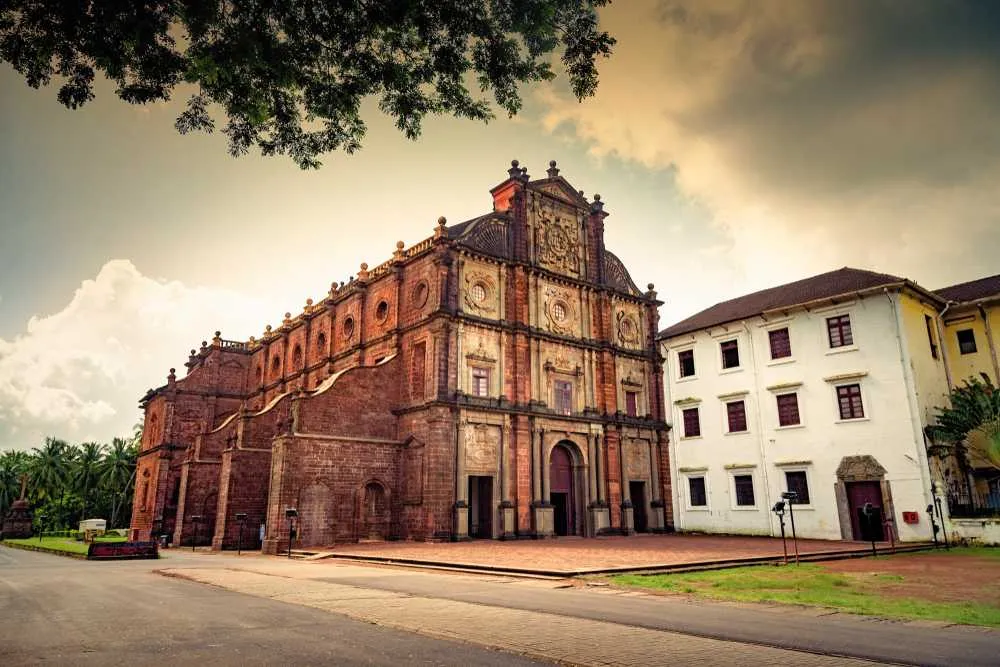
This Jesuit church is India's first minor basilica, and is considered to be one of the best examples of baroque architecture and Portuguese colonial architecture in India.
The façade is made of granite and represents features of Roman, Ionic, Doric, Corinthian, and Composite architectural styles. It is a large single Nave structure It is the only monument with a façade not covered with plaster.
The facade is three-stories high. It is un-plastered and is divided into four parts. The lowest section has three doors set into it, a large one in the middle with two smaller ones flanking it. The second section has three square windows whose positioning corresponds to that of the doors. The third section has three circular windows whilst the top-most section forms a quadrangle, lavishly decorated with arabesque. This quadrangular pediment also has “IHS” carved into it. This is the Jesuit emblem and stands for "Iesus Hominum Salvator", which is Latin for, “Jesus, Saviour of Men”. All the sections have carved basalt pillars. The basalt was mined from Bassein in the North of Goa.
The floor is of marble inlaid with precious stones. Apart from the elaborate gilded altars, the interior of the church is simple. The main altar is in Baroque style. It is backed by an ornate reredos which stretches from floor to ceiling. The gilded altar bears the statue of St. Ignatius of Loyola standing between Solomonic pillars, holding the infant Jesus. St. Ignatius of Loyola was the founder of the Society of Jesus (Jesuits) and one of Francis Xavier's closest companions. The gaze of the gilded statue of Ignatius of Loyola is fixed upwards in awe at the name of Jesus (IHS) on the gilded emblem of the Jesuits, encircled in radiant rays. Over the emblem, is the Holy Trinity - Father, Son and Spirit. The altar table is adorned with the figures of Christ and his apostles at the Last Supper, along with the words "Hi Mhoji Kudd", which in Konkani means "This is my Body".
There are two altars in the transept flanking the central one. They are highly carved and decorated and are dedicated to St. Michael and Our Lady of Good Hope.
The basilica is laid out in the orthodox cruciform fashion with a single nave and transept. The ceiling was once vaulted, but has since been replaced with a simple wooden one. The interiors, while being furnished with the best of materials show a remarkable simplicity typical of Renaissance design. The Basilica contains two chapels, three altars, a sacristy and a choir loft. There is also a belfry at the back. The door through which one enters stands beneath the choir loft. To the right is an altar which is dedicated to St. Anthony and to the left is a well-carved statue of St. Francis Xavier.
On the northern side of the transept is the Chapel of the Blessed Sacrament. On the southern side is the Chapel of St. Francis Xavier. This chapel has carved and gilded columns and wood-carved floral decorations. This is where the relics of the saint are kept. There is a gorgeous silver statue placed in front of the silver casket where the body of St. Francis Xavier reposes. The casket is made up of silver panels which depict 32 scenes from the life of the saint. These panels were created for this purpose by Goan silversmiths.
The construction of the Professed house, which lies next door to the Basilica, began in 1585, a few years before the basilica. It is a two-storied building, built of laterite rock and covered with lime plaster. Its construction was completed in 1589. This became the mission centre for all Jesuit missions to the eastern regions of the known world and was popularly known as the “Casa Professa”.