
explore.loading_image
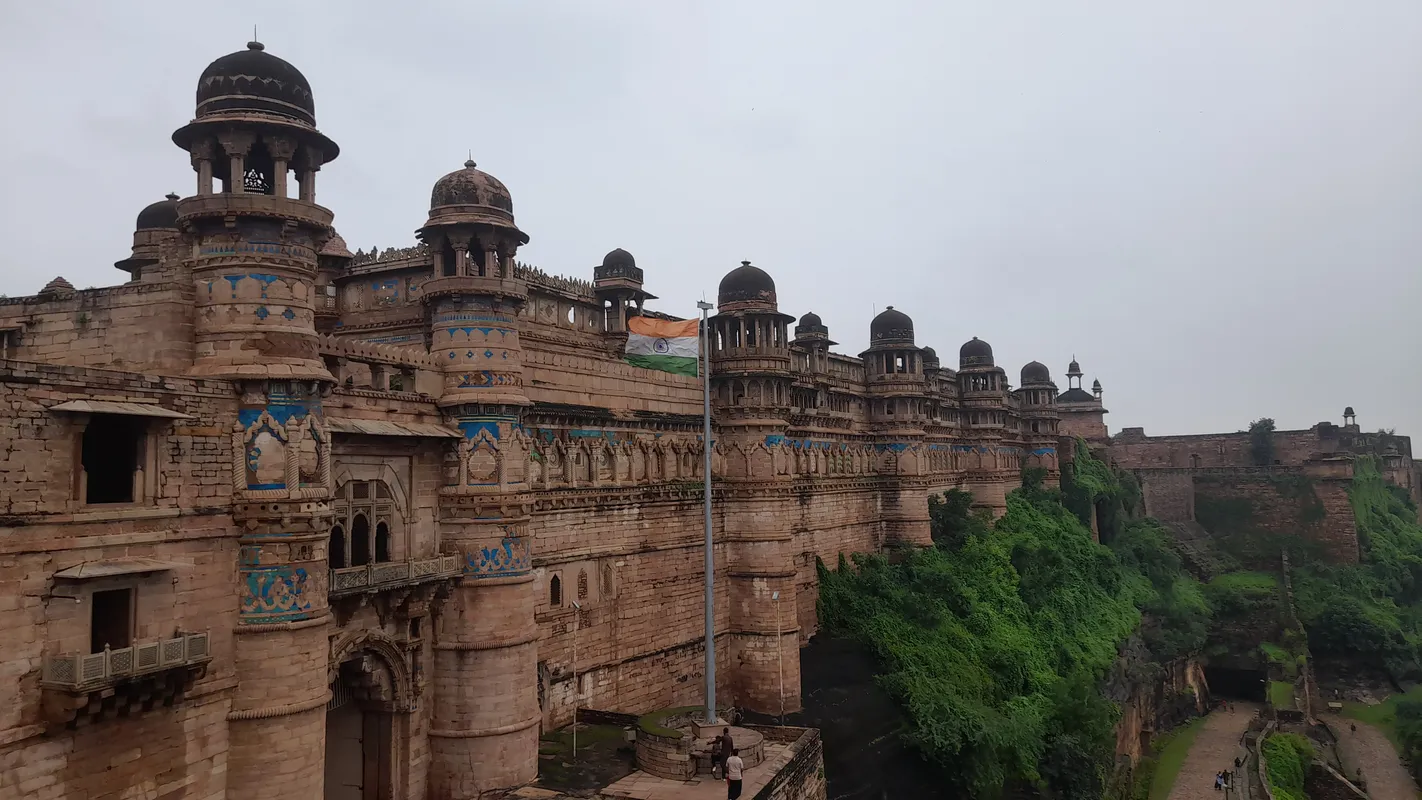
Gwalior Fort
Gwalior, Madhya Pradeshexplore.built_in_year
Historical Monumentsexplore.unesco_tentative
explore.cta_plan_trip_blurb
explore.cta_plan_tripexplore.cta_review_blurb
The historic fortress of Gwalior, was initiated by Raja Sourya Sena who finished the fortification system around the plateau in 773CE. The names mentioned in the old Sanskrit Inscriptions of the early years are Gopachala, Gopagiri, and other allied names all meaning ‘cowherds’ hill. The modern name Gwalior appears to have been derived from ‘Gopalikera’, one of the ancient names.
The fort sits atop the northern end of the 2.8km long rocky outcrop of the Vindhya mountains, with a width of about 900m, and a maximum height of 104m. The fort measures nearly 2.5km in length and varies between 200m and 725m in width.
It is approached from the east through a steep road that passes through a succession of gates - the Badal gate is at the foot of the hill, and is named after Badal Singh, Raja Man Singh's uncle. It is also known as the "Hindola Pol"; the Ganesh gate is the next gate. It is a simple gate built by Dungar Singh in the first half of the 16th century, with a kabutar khana (dove cote) and a small tomb erected by Motamid Khan in 1664; the Lakshman gate is further up the hill side and attributed to the Kachhawaha ruler, Lakshman Pal dating back to the 9th century; the Hathi pol or elephant gate is the last gate through which one gains access to the fort itself.
The Man Mandir Palace is the most magnificent structure in the fort. It was built by Raja Man Singh in 1508 CE. There are a total of 4 storeys to the palace, with the principal entrance on the 3rd storey, giving the impression that the two lower storeys are underground. The plan of the 3rd storey has two open courtyards surrounded by decorated rooms supported by pillars. The courtyards have decorated jharokhas and balconies on the upper storey, with sloping eaves and corbels separating the upper storey from the lower one. The walls of the palace are decorated with mosaic images made of glazed tiles of rich blue and yellow. Figures like humans, ducks, peacocks, elephants, lions, plantain trees, and flowers are seen on the decorated walls of the palace. The windows of the lower storeys look out upon the cliff on the east, and onto the courtyard on the south.
Domed turrets, a row of elegantly carved brackets supporting the eaves, and a few horizontal bands of carved moulding that are inlaid with enameled tiles break up the simple and massive facade of the palace. There are four domed turrets along the eastern wall of the palace, forming an almost sheer drop of 25m. The domed turrets of the Hathi pol gate form the southern extremity of the palace. There are two more domed turrets along the southern wall of the palace, while the western and northern ends are relatively plain. There are four smaller domed pavilions along the eastern face and three along the southern face, dividing the wall equally between the larger and smaller turrets.
Vestiges of the Bagh Paintings are found on the glazed tiles adorning the façade of the Man Mandir palace.
Other palaces and structures in the fort complex include
The Jahangir Palace and Shah Jahan Palace were constructed in the time of the respective Mughal emperors. They feature the typical arched doors, carvings, lattice windows, and domed gazebos typical of the mughal architectural style. There is a large courtyard with a stepped-well tank in the middle. The Shah Jahan palace is on the north-eastern side of the courtyard, The original Jahangir palace is most likely attributable to Sher Shah suri, with Jahangir having contributed to its upkeep and repairs rather than having commissioned it.
The Vikram Mahal was constructed by Raja Vikramaditya, Man Singh's son and successor between 1516 and 1523 CE. It is simple in style with a baradari (pavilion) in the middle with rooms on two sides of the courtyard, and stair case leading to the upper storey.
The Karn Mahal built by Kirti Singh, the second ruler of the Tomar dynasty, is on the west of the Vikram Mahal. It is a much larger structure comprising of three storeys. with pillared jharokhas (balconys) projecting from the uppermost storey, and a large pillared open courtyard on the first storey. A tower with domed turret stands at the northern end of the palace, while an elegant baradari pavilion stands detached on the south of the palace. The Johar Kund is a square reservoir measuring 58m by 46m, with a platform and two sets of steps leading down to the water level on the southern side. The women in the palace harem committed suicide by jumping into the reservoir when the fort fell to Muslim invaders in 1232 CE, giving it its name.
The Cenotaph of Bhimsingh Rana standing on the northern side of the tank, was constructed by Jat rulers in the memory of Bhim Singh Rana, the jat king of Gohad from 1754 to 1756, after he was killed in war against the Marathas. The three-storeyed structure stands on a four foot high terrace, and has a square footprint. There is a pillared verandah on the lowest floor, with square rooms on the two upper floors, and mounted by a bulbous dome topped by inverted lotus petals and a finial.
The armory building on the west of Johar Kund is a British area structure, with a distinctively colonial design - in its long halls running north-south from a central hall. Its entrance features a two-storeyed porch with a pediment and tall pillars.
The assi khamba ki baodi is a circular step-well, a little to the south and west of Man Mandir palace. It has an elegant pavilion with eighty pillars (giving the structure its name) with an entrance on the north and the well on the south. A small portico with a domed roof looks out on the east.
The Chaturbhuj Temple stands a short distance outside the Lakshman gate. It is a small temple (3.5m x 3.5m) with a square base, a pyramidal shrine, and a portico in front resting on pillars. It is dedicated to Vishnu. It has sculptures depicting Ganesha, Kartikeya, Parvati, etc. The temple is known for having one of the earliest depictions of the number "0" in an inscription found on its walls. The inscription states, among other things, that the community planted a garden of 187 hastas by 270 hastas (1 hasta = 1.5 feet), that the garden yielded 50 garlands for the temple every day. The last digits of 270 and 50 are O-shaped.
The Saas-Bahu Temple is the colloquial name assigned to the twin buildings on the south-eastern side of the fort. The original name of the temple was almost certainly Sahasra-baahu temple (the temple of the thousand-armed one), which has been corrupted to Saas-Bahu temple (meaning mother-in-law and daughter-in-law temple), which conveniently denotes the larger and smaller of the two structures. This is a temple of Vishnu, and is a grand example of the architectural style of the Kachchhapaghata rulers. The construction started during the reign of King Ratanpala, and was completed during the reign of Mahipala in 1093 CE.
Unusually, the temple plan is on a north-south axis with its entrance on the north, and the ardha-mandapa, maha mandapa, antarala, and garbha griha along the axis towards the south. The maha mandapa has exquisitely carved pillars and a lofty ceiling. There are porches on the east and west of this central hall. The exterior walls feature floral and geometric designs, elephants, dancers, musicians, and scenes from Krishna's life. The temple is 30m long and 19m at its widest (where the two porches project from the central maha mandapam). The height of the severely damaged spire now stands at 21m, and is estimated to have been over 30m originally. The temple stands on a pedestal 3.5m in height, and decorated with elaborate mouldings.
The smaller temple standing on the east of the larger temple boasts of a richly pillared open hall, with an entrance on the north. There are benches all around the perimeter of the structure with a stone railing flaring upwards and outwards. The temple does not currently have a sanctum although there is evidence of a southern extension of a size similar to the entrance porch on the north, indicating the position of the garbha griha. The temple has a cruciform base with a north-south length of 14m and an east-west width of 10m with porches at the ends of the eastern and western transepts. It stands on a 2m high plinth. The roof has the shape of a shallow pyramid, with a smaller spire over the porches on the north, east, and west.
The Teli temple is the tallest structure in Gwalior fort, at about 25m. It has a square base of about 18.3m, with a portico (mukha-mandapam) projecting 3.35m eastwards. The spire tapers to a width of 9m at the top, ending in a wagon-vaulted shape, unusually for a shrine in northern India as this is usually seen in temples and more specifically gopurams in southern India.
It is attributed to the Pratihara King Mihir Bhoja, while the name refers to the oil dealer who funded its construction (there is no relationship of the principal characters in the construction of this temple to the personae in the story of Raja Bhoj and Gangu Teli).
The gateway on the east is a British era addition attributed to Major Keith in the year 1881.
The Tomb of Mohammad Ghous is dedicated to Mohammad Ghous, a 16th century sufi saint. It has a square base, with hexagonal towers at the four corners, each surmounted by a domed canopy. The building is closed on three sides with elaborate and delicate stone lattice windows rising two storeys high, above which are the eaves. A large dome rises above the roof, supported on a square hall, and with small domed cupolas at the cour corners, and a finial projecting over its center.
The entrance to the tomb itself is on the south, while the present day entrance to the complex is on the north.
The Tomb of Tansen, the famous singer in the court of King Akbar stands on the south-west of Mohammad Ghous' tomb, within the same complex. Tansen was the discovery of and a disciple of Mohammad Ghous. It is in the form of a simple pillared pavilion with a low stone railing with delicate lattice decoration.
The Gopachal Jain sculptures are situated on the eastern cliff-face at the southern end of the hill. These are a set of 26 images of standing and seated Jain Tirthankaras. While there are some natural caves which have been used to carve out these images, most of them are carved into man made niches. There is a clever use of the stone as a natural screen beyond which the head and feet of the statue are visible, but the torso and mid-riff are hidden. The inscriptions on the pedestals refer to the Tomar King Dungar Singh who reigned from 1425-1459 CE, suggesting the vintage of these sculptures.
A well near cave No. 1 is known as the Ek Patthar ki baoli
The Siddhanchal Jain sculptures are situated on the western side of the hill, inside the Urvahi Gate of the fort. The statues depict all 24 Tirthankaras depicting them in both seated and standing poses. The reliefs behind some of them narrate scenes from the Jain legends.
The Jay Vilas palace is a nineteenth century palace built in European style. It was built in 1874 by Jayajirao Scindia and designed by Lt. Col. Sir Michael Filose. The major part of the palace is now the "Jiwajirao Scindia Museum" which opened to the public in 1964.
The interior of the Durbar Hall is decorated with gilt and gold furnishings and adorned with a huge carpet and gigantic chandeliers. It is 30m long, 15m wide, and 12m in height.
The fort sits atop the northern end of the 2.8km long rocky outcrop of the Vindhya mountains, with a width of about 900m, and a maximum height of 104m. The fort measures nearly 2.5km in length and varies between 200m and 725m in width.
It is approached from the east through a steep road that passes through a succession of gates - the Badal gate is at the foot of the hill, and is named after Badal Singh, Raja Man Singh's uncle. It is also known as the "Hindola Pol"; the Ganesh gate is the next gate. It is a simple gate built by Dungar Singh in the first half of the 16th century, with a kabutar khana (dove cote) and a small tomb erected by Motamid Khan in 1664; the Lakshman gate is further up the hill side and attributed to the Kachhawaha ruler, Lakshman Pal dating back to the 9th century; the Hathi pol or elephant gate is the last gate through which one gains access to the fort itself.
The Man Mandir Palace is the most magnificent structure in the fort. It was built by Raja Man Singh in 1508 CE. There are a total of 4 storeys to the palace, with the principal entrance on the 3rd storey, giving the impression that the two lower storeys are underground. The plan of the 3rd storey has two open courtyards surrounded by decorated rooms supported by pillars. The courtyards have decorated jharokhas and balconies on the upper storey, with sloping eaves and corbels separating the upper storey from the lower one. The walls of the palace are decorated with mosaic images made of glazed tiles of rich blue and yellow. Figures like humans, ducks, peacocks, elephants, lions, plantain trees, and flowers are seen on the decorated walls of the palace. The windows of the lower storeys look out upon the cliff on the east, and onto the courtyard on the south.
Domed turrets, a row of elegantly carved brackets supporting the eaves, and a few horizontal bands of carved moulding that are inlaid with enameled tiles break up the simple and massive facade of the palace. There are four domed turrets along the eastern wall of the palace, forming an almost sheer drop of 25m. The domed turrets of the Hathi pol gate form the southern extremity of the palace. There are two more domed turrets along the southern wall of the palace, while the western and northern ends are relatively plain. There are four smaller domed pavilions along the eastern face and three along the southern face, dividing the wall equally between the larger and smaller turrets.
Vestiges of the Bagh Paintings are found on the glazed tiles adorning the façade of the Man Mandir palace.
Other palaces and structures in the fort complex include
The Jahangir Palace and Shah Jahan Palace were constructed in the time of the respective Mughal emperors. They feature the typical arched doors, carvings, lattice windows, and domed gazebos typical of the mughal architectural style. There is a large courtyard with a stepped-well tank in the middle. The Shah Jahan palace is on the north-eastern side of the courtyard, The original Jahangir palace is most likely attributable to Sher Shah suri, with Jahangir having contributed to its upkeep and repairs rather than having commissioned it.
The Vikram Mahal was constructed by Raja Vikramaditya, Man Singh's son and successor between 1516 and 1523 CE. It is simple in style with a baradari (pavilion) in the middle with rooms on two sides of the courtyard, and stair case leading to the upper storey.
The Karn Mahal built by Kirti Singh, the second ruler of the Tomar dynasty, is on the west of the Vikram Mahal. It is a much larger structure comprising of three storeys. with pillared jharokhas (balconys) projecting from the uppermost storey, and a large pillared open courtyard on the first storey. A tower with domed turret stands at the northern end of the palace, while an elegant baradari pavilion stands detached on the south of the palace. The Johar Kund is a square reservoir measuring 58m by 46m, with a platform and two sets of steps leading down to the water level on the southern side. The women in the palace harem committed suicide by jumping into the reservoir when the fort fell to Muslim invaders in 1232 CE, giving it its name.
The Cenotaph of Bhimsingh Rana standing on the northern side of the tank, was constructed by Jat rulers in the memory of Bhim Singh Rana, the jat king of Gohad from 1754 to 1756, after he was killed in war against the Marathas. The three-storeyed structure stands on a four foot high terrace, and has a square footprint. There is a pillared verandah on the lowest floor, with square rooms on the two upper floors, and mounted by a bulbous dome topped by inverted lotus petals and a finial.
The armory building on the west of Johar Kund is a British area structure, with a distinctively colonial design - in its long halls running north-south from a central hall. Its entrance features a two-storeyed porch with a pediment and tall pillars.
The assi khamba ki baodi is a circular step-well, a little to the south and west of Man Mandir palace. It has an elegant pavilion with eighty pillars (giving the structure its name) with an entrance on the north and the well on the south. A small portico with a domed roof looks out on the east.
The Chaturbhuj Temple stands a short distance outside the Lakshman gate. It is a small temple (3.5m x 3.5m) with a square base, a pyramidal shrine, and a portico in front resting on pillars. It is dedicated to Vishnu. It has sculptures depicting Ganesha, Kartikeya, Parvati, etc. The temple is known for having one of the earliest depictions of the number "0" in an inscription found on its walls. The inscription states, among other things, that the community planted a garden of 187 hastas by 270 hastas (1 hasta = 1.5 feet), that the garden yielded 50 garlands for the temple every day. The last digits of 270 and 50 are O-shaped.
The Saas-Bahu Temple is the colloquial name assigned to the twin buildings on the south-eastern side of the fort. The original name of the temple was almost certainly Sahasra-baahu temple (the temple of the thousand-armed one), which has been corrupted to Saas-Bahu temple (meaning mother-in-law and daughter-in-law temple), which conveniently denotes the larger and smaller of the two structures. This is a temple of Vishnu, and is a grand example of the architectural style of the Kachchhapaghata rulers. The construction started during the reign of King Ratanpala, and was completed during the reign of Mahipala in 1093 CE.
Unusually, the temple plan is on a north-south axis with its entrance on the north, and the ardha-mandapa, maha mandapa, antarala, and garbha griha along the axis towards the south. The maha mandapa has exquisitely carved pillars and a lofty ceiling. There are porches on the east and west of this central hall. The exterior walls feature floral and geometric designs, elephants, dancers, musicians, and scenes from Krishna's life. The temple is 30m long and 19m at its widest (where the two porches project from the central maha mandapam). The height of the severely damaged spire now stands at 21m, and is estimated to have been over 30m originally. The temple stands on a pedestal 3.5m in height, and decorated with elaborate mouldings.
The smaller temple standing on the east of the larger temple boasts of a richly pillared open hall, with an entrance on the north. There are benches all around the perimeter of the structure with a stone railing flaring upwards and outwards. The temple does not currently have a sanctum although there is evidence of a southern extension of a size similar to the entrance porch on the north, indicating the position of the garbha griha. The temple has a cruciform base with a north-south length of 14m and an east-west width of 10m with porches at the ends of the eastern and western transepts. It stands on a 2m high plinth. The roof has the shape of a shallow pyramid, with a smaller spire over the porches on the north, east, and west.
The Teli temple is the tallest structure in Gwalior fort, at about 25m. It has a square base of about 18.3m, with a portico (mukha-mandapam) projecting 3.35m eastwards. The spire tapers to a width of 9m at the top, ending in a wagon-vaulted shape, unusually for a shrine in northern India as this is usually seen in temples and more specifically gopurams in southern India.
It is attributed to the Pratihara King Mihir Bhoja, while the name refers to the oil dealer who funded its construction (there is no relationship of the principal characters in the construction of this temple to the personae in the story of Raja Bhoj and Gangu Teli).
The gateway on the east is a British era addition attributed to Major Keith in the year 1881.
The Tomb of Mohammad Ghous is dedicated to Mohammad Ghous, a 16th century sufi saint. It has a square base, with hexagonal towers at the four corners, each surmounted by a domed canopy. The building is closed on three sides with elaborate and delicate stone lattice windows rising two storeys high, above which are the eaves. A large dome rises above the roof, supported on a square hall, and with small domed cupolas at the cour corners, and a finial projecting over its center.
The entrance to the tomb itself is on the south, while the present day entrance to the complex is on the north.
The Tomb of Tansen, the famous singer in the court of King Akbar stands on the south-west of Mohammad Ghous' tomb, within the same complex. Tansen was the discovery of and a disciple of Mohammad Ghous. It is in the form of a simple pillared pavilion with a low stone railing with delicate lattice decoration.
The Gopachal Jain sculptures are situated on the eastern cliff-face at the southern end of the hill. These are a set of 26 images of standing and seated Jain Tirthankaras. While there are some natural caves which have been used to carve out these images, most of them are carved into man made niches. There is a clever use of the stone as a natural screen beyond which the head and feet of the statue are visible, but the torso and mid-riff are hidden. The inscriptions on the pedestals refer to the Tomar King Dungar Singh who reigned from 1425-1459 CE, suggesting the vintage of these sculptures.
A well near cave No. 1 is known as the Ek Patthar ki baoli
The Siddhanchal Jain sculptures are situated on the western side of the hill, inside the Urvahi Gate of the fort. The statues depict all 24 Tirthankaras depicting them in both seated and standing poses. The reliefs behind some of them narrate scenes from the Jain legends.
The Jay Vilas palace is a nineteenth century palace built in European style. It was built in 1874 by Jayajirao Scindia and designed by Lt. Col. Sir Michael Filose. The major part of the palace is now the "Jiwajirao Scindia Museum" which opened to the public in 1964.
The interior of the Durbar Hall is decorated with gilt and gold furnishings and adorned with a huge carpet and gigantic chandeliers. It is 30m long, 15m wide, and 12m in height.