
explore.cta_plan_trip_blurb
explore.cta_plan_tripexplore.cta_review_blurb
The Kamakhya Temple in Guwahati, stands on a hill called the Nilachala. This temple is recognized as one of the primary Shakti-peetha. The Kamakhya Temple is the place where Sati’s yoni (vagina) fell. Hence, this temple has a reputation as a temple of fertility.
The current structure can be traced back to the reign of the Koch ruler, Nar Narayan (1540-1595). The temple was built using the stones from a ruined temple of the 12th century, presumably on the same site. The last section (the Natmandir) is a later-day addition attributed to King Rajewara Singh (1751-1769).
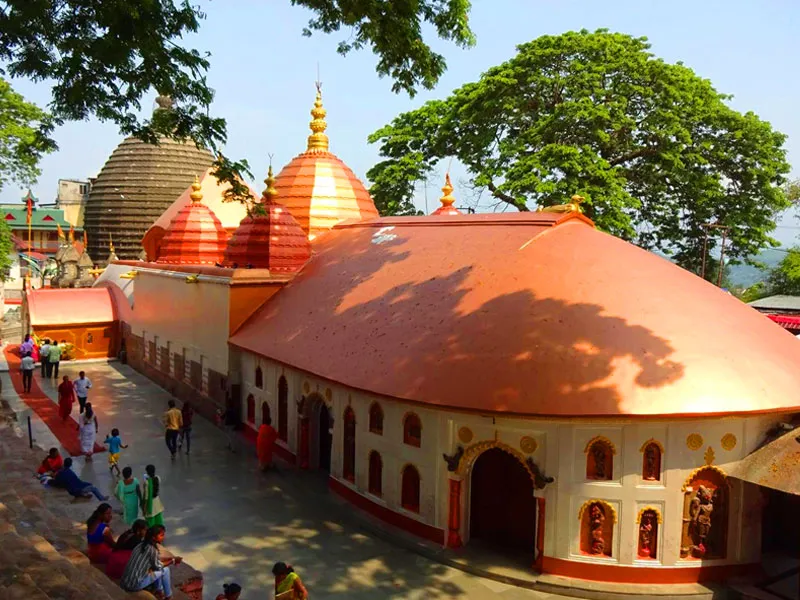
The temple has the traditional five sections aligned axially from west to east – the Natmandir (dance hall), the Bhog Mandir (hall of ritual offerings), the jagamohan or sabha mandapam (the hall for public gatherings), and an antarala (ante-chamber) which leads to the garbhagriha (sanctum sanctorum), which is furthest to the east.
The principal shrine has a dome made of brick with a sixteen-sided polygon at its base, rising through 20 successively shrinking polygons, topped by a kalasha. with a floral base and a finial. This style combines elements of the rekha-nagara style with elements of the Indo-Saracenic dome. This dome, with a diameter of about 11m, is surrounded by a ring of smaller spires of the chala style, each with a finial ending in a trident. The pairs of spires on the East, North, and South are slightly larger and less ornate than the other spires in this ring. While the bands which form the main spire are largely devoid of ornamentation, the smaller spires have walls with figures of dancers and floral medallions.
The walls of the sanctum have floral designs, as well as images of Vishnu carved into them. These near-identical images of Vishnu feature distinctive hand poses (mudra). A frieze with depictions of yoginis runs along the base of the walls.
The antarala has a chala styled roof, the bhog mandir has a five-spired (pancharatna) design with one large central domic spire and four smaller spires at the four corners of the roof. The Natmandir which forms the front of the temple has a shell-style roof. A figure of a bird adorns this shell roof at the western edge of the ridge running along the roof. While these sections of the temple are contiguous, a detached structure in front serves as the hall of sacrifices.
The walls of the Natamandir feature images inspired by the legends of Vishnu installed in niches. There are two levels of such niches. The doorways have flying dwara palakas carved above the lintel, and large images of Vishnu flanking the doorway.
The Umananda temple sits on a small forested island in the River Brahmaputra. This temple is the complement to the Kamakhya temple and houses Shiva, the consort of the Parvati who is the presiding deity of the Kamakhya temple. It features a domed spire and a jagamohan in front. The temple structure is of recent vintage.
The current structure can be traced back to the reign of the Koch ruler, Nar Narayan (1540-1595). The temple was built using the stones from a ruined temple of the 12th century, presumably on the same site. The last section (the Natmandir) is a later-day addition attributed to King Rajewara Singh (1751-1769).
The temple has the traditional five sections aligned axially from west to east – the Natmandir (dance hall), the Bhog Mandir (hall of ritual offerings), the jagamohan or sabha mandapam (the hall for public gatherings), and an antarala (ante-chamber) which leads to the garbhagriha (sanctum sanctorum), which is furthest to the east.
The principal shrine has a dome made of brick with a sixteen-sided polygon at its base, rising through 20 successively shrinking polygons, topped by a kalasha. with a floral base and a finial. This style combines elements of the rekha-nagara style with elements of the Indo-Saracenic dome. This dome, with a diameter of about 11m, is surrounded by a ring of smaller spires of the chala style, each with a finial ending in a trident. The pairs of spires on the East, North, and South are slightly larger and less ornate than the other spires in this ring. While the bands which form the main spire are largely devoid of ornamentation, the smaller spires have walls with figures of dancers and floral medallions.
The walls of the sanctum have floral designs, as well as images of Vishnu carved into them. These near-identical images of Vishnu feature distinctive hand poses (mudra). A frieze with depictions of yoginis runs along the base of the walls.
The antarala has a chala styled roof, the bhog mandir has a five-spired (pancharatna) design with one large central domic spire and four smaller spires at the four corners of the roof. The Natmandir which forms the front of the temple has a shell-style roof. A figure of a bird adorns this shell roof at the western edge of the ridge running along the roof. While these sections of the temple are contiguous, a detached structure in front serves as the hall of sacrifices.
The walls of the Natamandir feature images inspired by the legends of Vishnu installed in niches. There are two levels of such niches. The doorways have flying dwara palakas carved above the lintel, and large images of Vishnu flanking the doorway.
The Umananda temple sits on a small forested island in the River Brahmaputra. This temple is the complement to the Kamakhya temple and houses Shiva, the consort of the Parvati who is the presiding deity of the Kamakhya temple. It features a domed spire and a jagamohan in front. The temple structure is of recent vintage.
explore.label_base: 56 × 13 explore.label_meters
explore.label_height: 15 explore.label_meters