
explore.cta_plan_trip_blurb
explore.cta_plan_tripexplore.cta_review_blurb
The Meenakshi-Sundareswara Temple is located on the southern bank of the Vaigai River in the temple city of Madurai, Tamil Nadu, India.The presiding deities are Meenakshi, a form of Parvati, and her consort, Sundareshwar, a form of Shiva.
While a precise date for its construction is not known, the East Gopuram of the temple is known to be the oldest of the gopurams, and was constructed by Maravarman Sundarapandian, the Pandian King who reigned from 1216 to 1238 CE. This implies the central shrines of the temple are of older antiquity.
There is an outer wall within which there are two other inner walls, one surrounding the Sundarewara shrine, and one surrounding the Meenakshi amman shrine. There is an additional inner wall surrounding the Sundareswara shrine. The Sundarewara shrine is the larger of the two primary shrines, and occupies the central position along an east-west axis, while the Meenakshi amman shrine stands to the south.
There are gold-plated vimana above the sanctums of Sundareswar and Meenakshi amman. The vimana (spire) above the Sundareswar sanctum is held aloft by eight silver-coated sculpted elephants. These elephants are also known as the ashta-diggaja (elephants of the eight directions).
At the entrance to the Sundarewaara shrine there are two dwarapalakas (gatekeepers) of 12 feet height each, carved from a single stone. The pillars near this entrance door are decorated with 5-headed figures of Siva and Meenakshi Amman. Figures of four great Saivite Saints are carved on the other pillars in the immediate vicinity.
The secondary shrines in the complex include the Sevantheeswar and the Kasi-vishwanath shrines which are both located near the Meenakshi Amman shrine and have a square shaped sanctum; the Ekadashi Lingam shrine which is located in the second circumambulatory path of the Swami's sanctum and has figures of Ganesha and Murugan standing guard outside the sanctum; and the Sangathaar Sannathi which celebrates the Tamil Sangam, the third of which was supposed to have been held in Madurai.
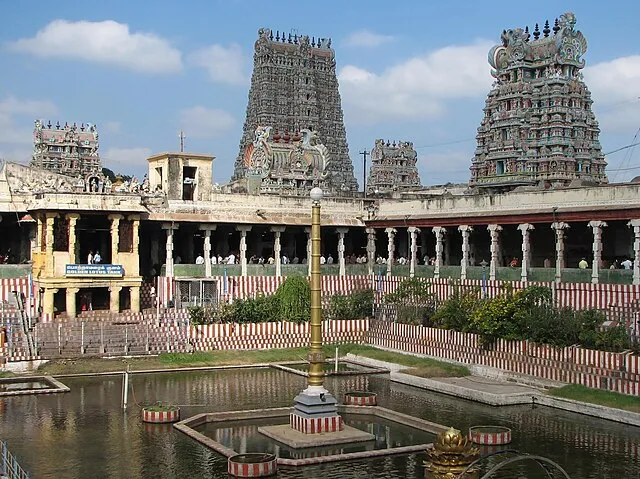
There are a total of twelve gateway towers (gopuram) in the sprawling 14.6 acre complex - with the four gopuram in the outer wall in the four cardinal directions being the most dominant features of the complex. All four of these outer gopurams are nine-tier, and have 9 kalasha (pot) on the top of the wagon-vaulted roof. There are four 5-tier gopuram, one on each side, of the first inner wall of the Sundareswara shrine, and one 3-tier gopuram on the eastern wall of the second inner wall of the Sundareswara shrine. The Meenakshi amman shrine has one 3-tier gateway on the eastern and one 5-tier gateway on the western side of the inner wall. The twelfth gopuram is a 7-tier gopuram which is axially aligned with the Meenakshi amman shrine, and stands east of the Golden Lotus tank. The eight inner gopurams are not easily visible to visitors because of the roofing that has been put in place in the hallways and the prakaram walkways.
Of the outer-wall gopurams, the southern gopuram is the tallest of all, at 49 m, with the other three ranging between 46m and 47m.
The complex has numerous sculpted pillared halls (mandapam) such as Ayirakkal (Thousand pillared hall), Kilikoondu-mandapam, Golu-mandapam and Pudu-mandapam.
The grandest part of the entire temple complex is the Thousand Pillared Mandapam, which actually has 985 pillars. It was completed in 1569 during the reign of Ariyanatha Mudaliar. It is located in the north east corner of the complex. It occupies an area of 60,000 square feet. The Mandapam faces south and its entrance on that side leads to a long central nave with two rows of pillars on either side of it. The Sabhapathi shrine which is over two stages of platforms stands at the northern end of this nave. The shrine contains a large image of Nataraja showing Him dancing on top of large Kurma Peetam. Yalli Pillars flank the approaches of the shrine. This nave divides the hall into east and west wings, which are filled with rows of pillars.
The group of figures on two rows of pillars at the entrance is each one a masterpiece by itself. The carvings on the first row of pillars are Angam Vettina Shiva, kannappar, Kankaalamurthi, Ariyanaatha Mudali, Harischandran, Chandramathi, Kurathi and Kuravan. On the second row of pillars are Pandya Kings, Thirupurari, Ganesha, Dwaarapaalakas, Subrahmanya, Naagaraja and Saraswathi. The central row of pillars feature fine sculptures of Kali, Uttara, Bhima, Purusha Miruga, Vedan, Rathi. Manmatha, Aghora Virabhadra, Mohini and Bikshaatanaar, among others. On some of the plain pillars a number of legendary and iconographic figures in a low relief are carved on the facets.
The combination of bracketed beam architecturally well composed is a good example of pillars with foliated brackets spreading out like a tree. The base of the mandapam on the western side has a frieze of panels depicting scenes from the legends in low relief.
Ariyanaatha Mudali was the general and minister of the four Nayakar rulers of Madurai. An equestrian statue of Ariyanaatha Mudali is on one of the front pillars in the hall.
The Pudhu Mandapam, also known as the Vasantha Mandapam, stands just outside the main compound wall on the east. It was built during 1628-1635, by the King Thirumalai Nayak as a summer abode for the Goddess Meenakshi and Lord Sundareswara.
The temple complex also boasts of detailed and brightly coloured Mural Paintings which occupy approximately 2,500 square feet around the Golden Lotus Tank and adjacent mandapams. They were painted during the reign of Tirumalai Nayak and his successors (17th century) using natural mineral pigments on lime plaster. The panels carry short inscriptions in Telugu and Tamil which provide additional details of the painting.
The murals (Tiruvilaiyadal Puranam) deal with three main themes: the Madurai Kandam, which narrate the story of the creation of Madurai, Meenakshi's birth, marriage, and early miracles; the Koodal Kandam, which deal with the miracles performed within Madurai city; and the Alavai Kandam, which depicts Poets, saints, grammar, Manikkavachakar, Sambandar and later miracles.
The Wedding of Meenakshi and Sundareswar mural is one of the most important paintings in the temple. It depicts the celestial wedding of bride Meenakshi and bridegroom Sundareswarar and is drawn on the roof of Oonjal Mandapam at the Amman sannidhi of this temple. The Telugu/Tamil text on the painting depicts Rani Mangamma, the then ruler of Madurai, with her grandson Vijayaranga Sokkanadar on the right, and the Commander of the royal army, Ramappayya on the left, respectively, witnessing the celestial wedding.
The Golden Lotus pond is a large tank measuring 27m x 43m. It stands on the southern side just inside the outer enclosure wall.
Rulers from the Cholas, Pandyas, Vijayanagara, and Nayak dynasties have all contributed to the architecture of the temple, with its current form attributable to the great expansion under the rule of the Nayakas - Viswanatha Nayak, Tirumala Nayak, and Rani Mangammal - who renovated and extended the temple, building several mandapam (pavilions), and the distinctive composite pillars featuring a mix of yalis and human figures.