
explore.cta_plan_trip_blurb
explore.cta_plan_tripexplore.cta_review_blurb
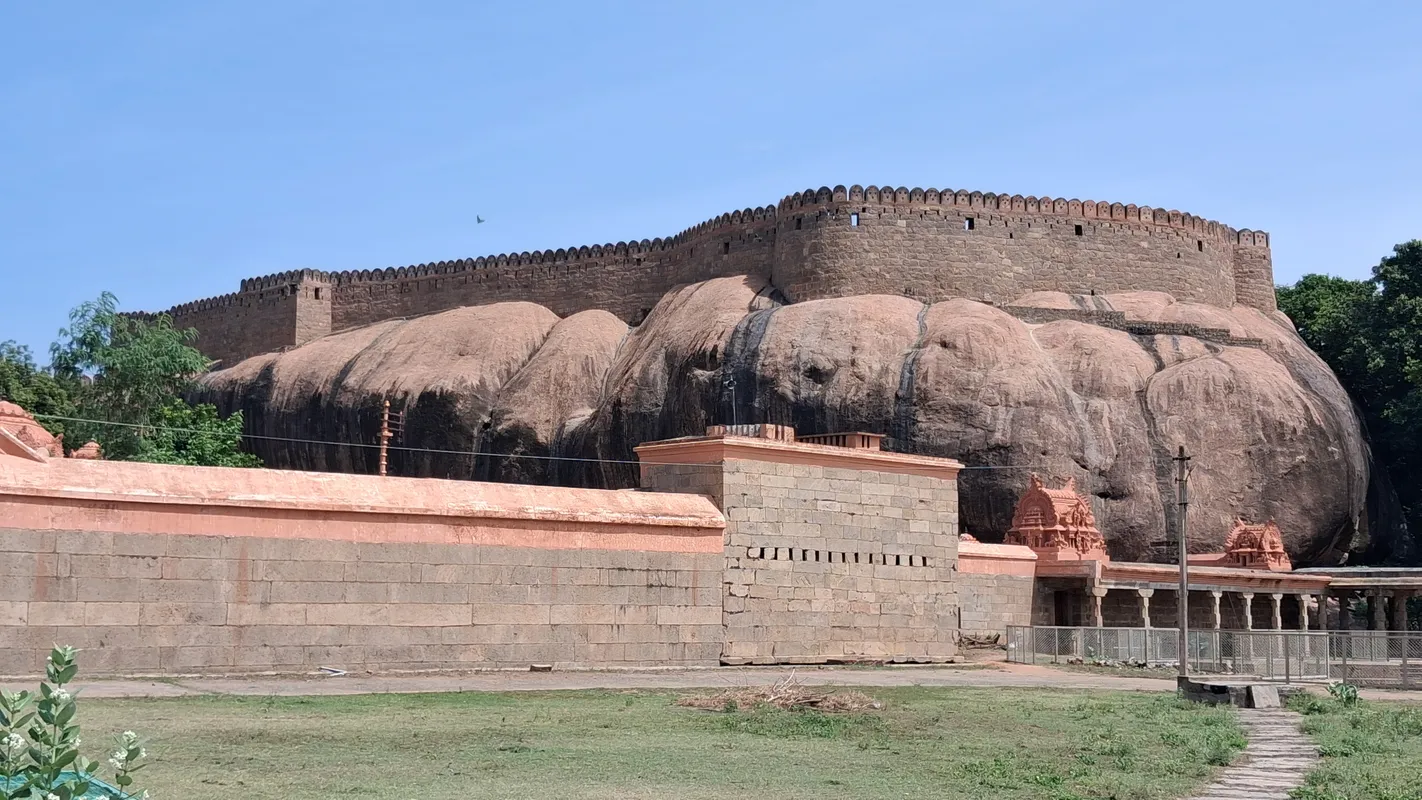
The fort was constructed by Vijaya Raghunatha Sethupathi, the Raja of Ramnad in 1687. The fort is said to originally have been a 'ring fort' with seven concentric walls. It has only four surviving rings now of which only the innermost is largely intact. The innermost wall, perched on top of a rocky outcrop, has a perimeter of approximately 330m, covering an area a little over 1.5 acres.
The fort is constructed of small blocks of stone along with bricks. The fort is perched on a set of large boulders. There are steps to enter the fort on the northwest. The fort walls has several embrasures provided for the defenders of the fort. The fort has three entrances on the north, south, and on the east. There are cannons mounted in the north, south and east gates, as well as another on the bastion on the peak of the hill.
The most noteworthy element of the fort are the two temples on the southern slope of the hill. There are two rock cut temples on the southern slope, one dedicated to Sri Sathyamurthy-Sri Uyyavanda Nachiar (Vaishnavite tradition) and another to Sri Sathyagireeswarar-Sri Venuvaneeswari (Saivite tradition). The temples are built around sancta which are in the form of caves cut into the rock face. The temples comprise an outer boundary wall, with prominent and highly decorated gopuram (gateway tower), and pillared hallways.
The larger of the two temple complexes is the easternmost one, and is a Vaishnavite shrine. There is a Narasimha temple, as well as a Rama-Lakshmana-Sita temple situated within the same complex. A statue of Sokkalingam Chettiar, the founder patron of the Rama temple, stands carved into a pillar in front of its sanctum.
There are three distinct styles of carvings that can be seen on the pillars in the sabha mandapam. There are a set of elegantly carved long-limbed dancing girls and guardsmen on the eastern side of the hall; some of the pillars are decorated with delicate floral, faunal, and geometric patterns; while a third set features religious iconography, drawing from the dashavatara and other gods and goddesses. The set of columns near the entrance feature the entire set of ten incarnations of Vishnu (dashavatara). These idols are carved near the base of the columns.
Some pillars in the sabha mandapam feature images of philosophers and teachers.
The sanctum of the Satyagiri shrine faces east, but the primary axis of the temple is north-south. This complex is smaller. It also features a pillared hallway (sabha mandapam) and an ardha mandapam which leads to the sanctum.
There is a small cave temple on the south-western side with a Shiva lingam in the sanctum. This temple is cut into a sheer cliff side and is only accessible via a ladder.
There are shrines dedicated to Hanuman, Sakthi, Ganapathi, Karuppar (guardian deities of the fort) on the southern side and a shrine to Bhairava on the northern side. There are several ponds and tanks within the circumference of the fort, with the large octagonal tank attached to the temple on the east with steps leading down to the water surface being the most prominent of them.