
Plan Your Journey
Tell us about your preferences and we'll create a personalized itinerary showcasing India's magnificent heritage.
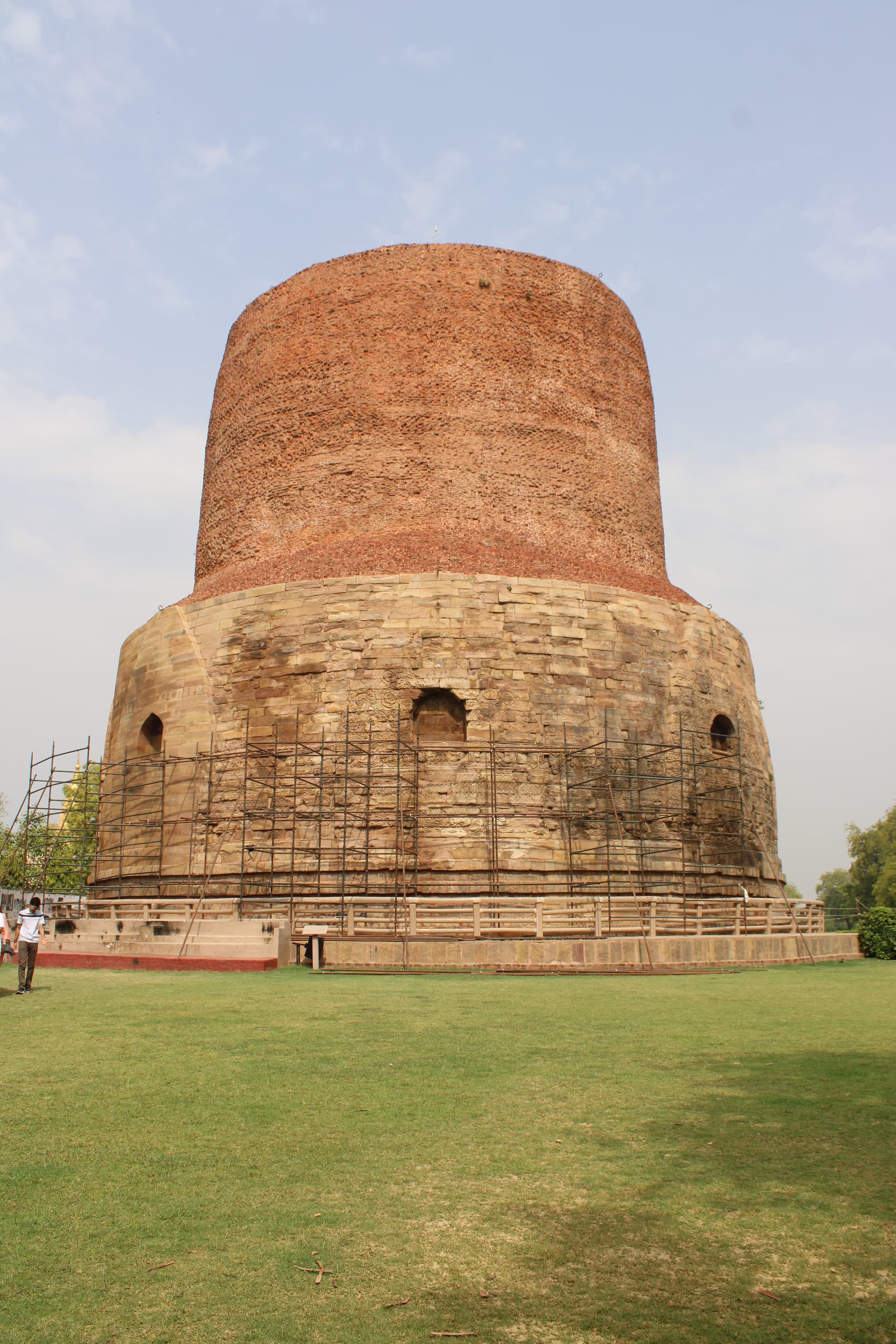
Dhamekh Stupa
Sarnath, Uttar Pradesh
Place of WorshipThe present structure of the Dhamekh stupa can be traced back to the 6th or 7th century. There exists a stupa made of Mauryan-era bricks which at the core of this stupa. <br><br> The structure consists of a circular stone drum up to the height of 13.11 meters, surmounted by a circular brick structure. <br><br> There are eight niches in eight directions, which are thought to originally have contained images of Lord Buddha. The eight niches are thought to be aligned with the eight-fold path. <br><br> Below these niches runs a broad course of beautifully carved stones with geometric designs incorporating the swastika, leaf and floral patterns, and figures of birds and humans. <br><br> A 15.25m high monolithic pillar once stood at this site. The pillar was surmounted by the <b>four lions capital</b> which is the emblem of India today. The pillar is made of Chunar sandstone. The cylindrical shaft tapers from a diameter of 0.71m at the base to 0.56m at the top. There are three inscriptions on the pillar dating from the Ashoka period in the Mauryan Brahmi script (where the king warns monks and nuns against creating a schism in the Buddhist sangha), the Kushan period (commemorating the fortieth year of Kushan Kingh Ashvaghosha of Kaushambi), and the early Gupta period in Brahmi script (referring to teachers of the Sammitya sect and the Vastiputrak school). The pillar is broken and its fragments can now be seen at the site. <br><br> The complex also includes the <b>Dharmarajika Stupa</b>, which was built by Ashoka to enshrine the relics of Lord Buddha. It was originally a small stupa of 49 feet in diameter, and was expanded through a course of six phases which added a circumambulatory path, gave it a medhi shape, and added monolithic staircases in the four cardinal directions. This stupa was pulled down in 1794 by Jagat Singh, who was the Divan of Raja Chet Singh of Benares to exploit its building materials, and a casket found at the site was thrown into the Ganges. <br><br> A monolith stone square railing made of Chunar sandstone with a length of 2.54 m and a height of 1.45m was found at the site. It bears typical Mauryan-era polish. It is supposed that this railing was positioned on top of the Dharmarajika stupa. It contains two inscriptions referring to teachers of the Sarvastivadin sect, dating back to the 3rd century BC. <br><br> One colossal Boddhisatva image in red sandstone dating from the Kushana period, and an image of a seated Buddha in Dharmachakra Pravartana mudra from the Gupta period were retrieved from the periphery of the Dharmarajika stupa. <br><br> The <b>Chaukhandi stupa</b> stands about 800m south of the Dhamekh stupa. It has a four armed plan. It probably marks the spot where Lord Buddha met his five erstwhile companions when he came from Bodh Gaya after enlightenment. This stupa was built during the Gupta period in the fourth or fifth century. This stupa is also mentioned in the travelogues of Hieun Tsang. It is a 93 feet high brick stupa, laid in mud mortar, having three diminishing square terraces each about 12 feet high and 12 feet broad. Each terrace is supported by an inner and ourter wall, with a number of cross walls to strengthen the structure. <br> The outer walls of the terraces are ornamented with a series of niches separated by pilasters. Images of Lord Buddha in Dharma Chakra pravartana pose, and Leogryphs with swordsmen found at the site are excellent examples of Gupta period art. <br> An octagonal brick tower stands on top of the stupa. As per an inscription in Arabic on a stone slab above the gateway on the North side informs that this was erected in 1588 by Govardhan, son of Raja Todarmal, to commemorate the visit of Emperor Humayun.