
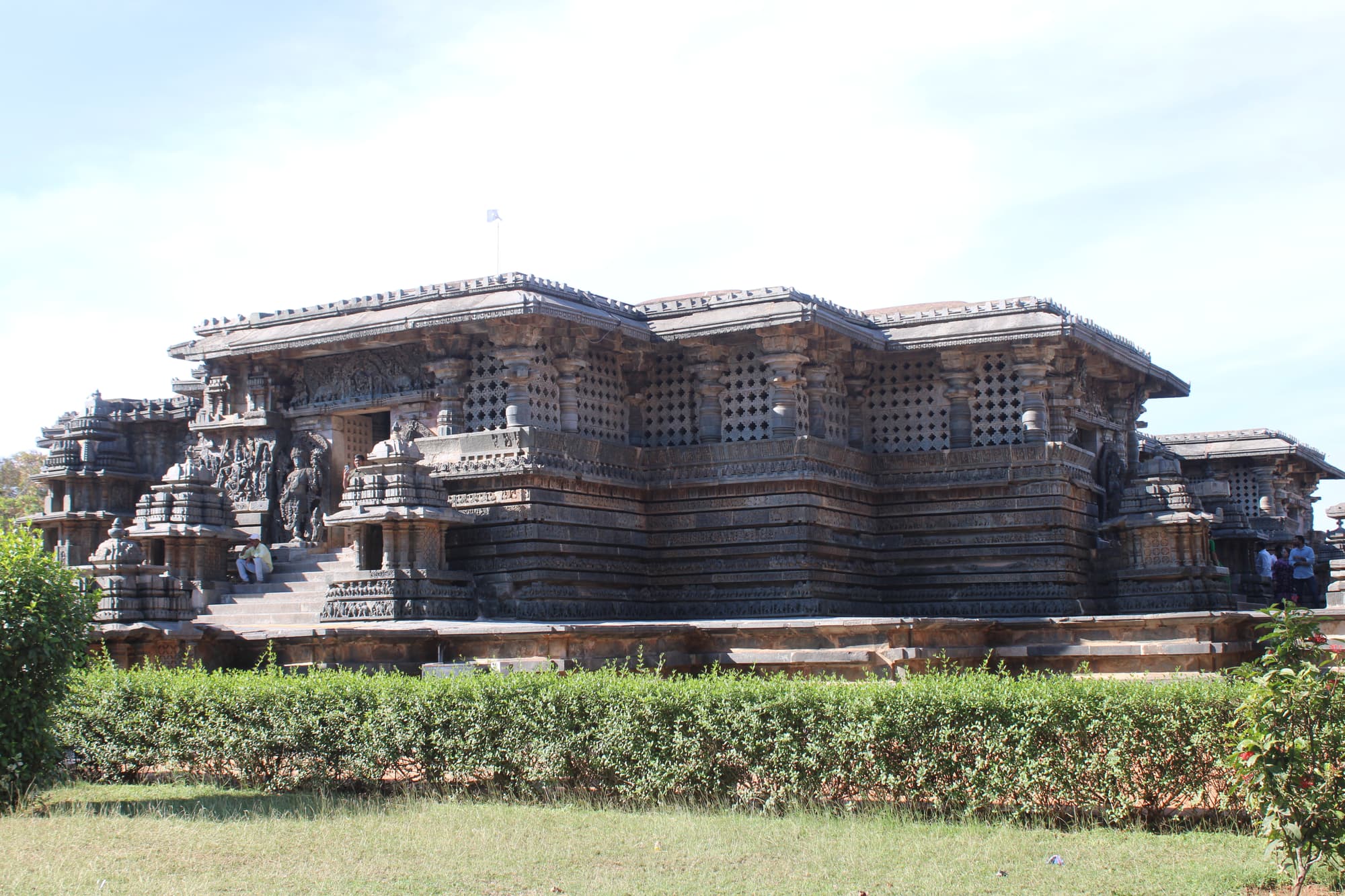
Hoyasaleshwara Temple
Halebidu, Karnataka
Place of WorshipThe Hoysaleswara temple is a twin-temple dedicated to Hoysaleshwara and Shantaleshwara, named after the masculine and feminine aspects of Shiva. The two temples are practically identical and are joined at their transept. There are two corresponding Nandi shrines in front, where each seated Nandi face the respective Shiva linga inside. A smaller sanctum for the the Sun god Surya stands in front (on the east) of the Hoyasaleshwara Temple. <br> The temples are understood to originally have had superstructure spires, but these are no longer present. Both the main temples and the Nandi shrines are based on a square plan, with a star-shaped <i>jagati</i> or platform. The platform on which two temples stand measures about 38m in the east-west direction, and 60m in the north-south direction. The two Nandi pavilions which have a square footprint, about 8m on the side. The platform has a 15-feet wide external pradakshana pitha (circumambulation path) around the outer walls of the temple. Most other Hindu temples have the circumambulation path inside the outer walls. <br><br> The twin temples are notable for their sculptures which include intricate reliefs work and detailed friezes. Inscriptions in North Indian and South Indian scripts provide details of historical events and patrons of the temple. There are about 340 large reliefs sculpted idols on the walls of the temple, especially the sides and the rear, depicting gods and themes from Hindu mythology. Numerous smaller friezes feature scenes drawn from the Ramayana, the Mahabharata, and the Bhagavata Purana. <br> The intricately carved outer walls have several parallel bands with friezes that consist of elephants, lions, scrolls with nature and miniature dancers, horses, another decorarive scroll, scenes from Hindu texts, and images of mythical beasts (makara) and swans. <br><br> The interior walls of the temple are relatively plain. The hallway features exquisitely polished lathe turned pillars that run in rows between the north and south entrances. In addition to these, there are four pillars in front of each shrine are the most ornate and the only ones that have the <i>madanika</i> (dancing woman) sculptures in their pillar brackets. <br><br> These Hoysala temples were constructed during the reign of the Hoysala dynasty between the 11th and 14th centuries. Other prominent temples of similar style and architectural style, with their characteristic star-shaped platforms, and ornate pillars, and elaborate carvings on the walls are the Chennakesava Temple in Belur, the Keshava Temple of Somanathapura, and the Kedareswara Temple a short distance away to the south-east. The Rudreshwara Temple (1000 pillar temple) of Warangal also features a similar design and ornamentation style.