
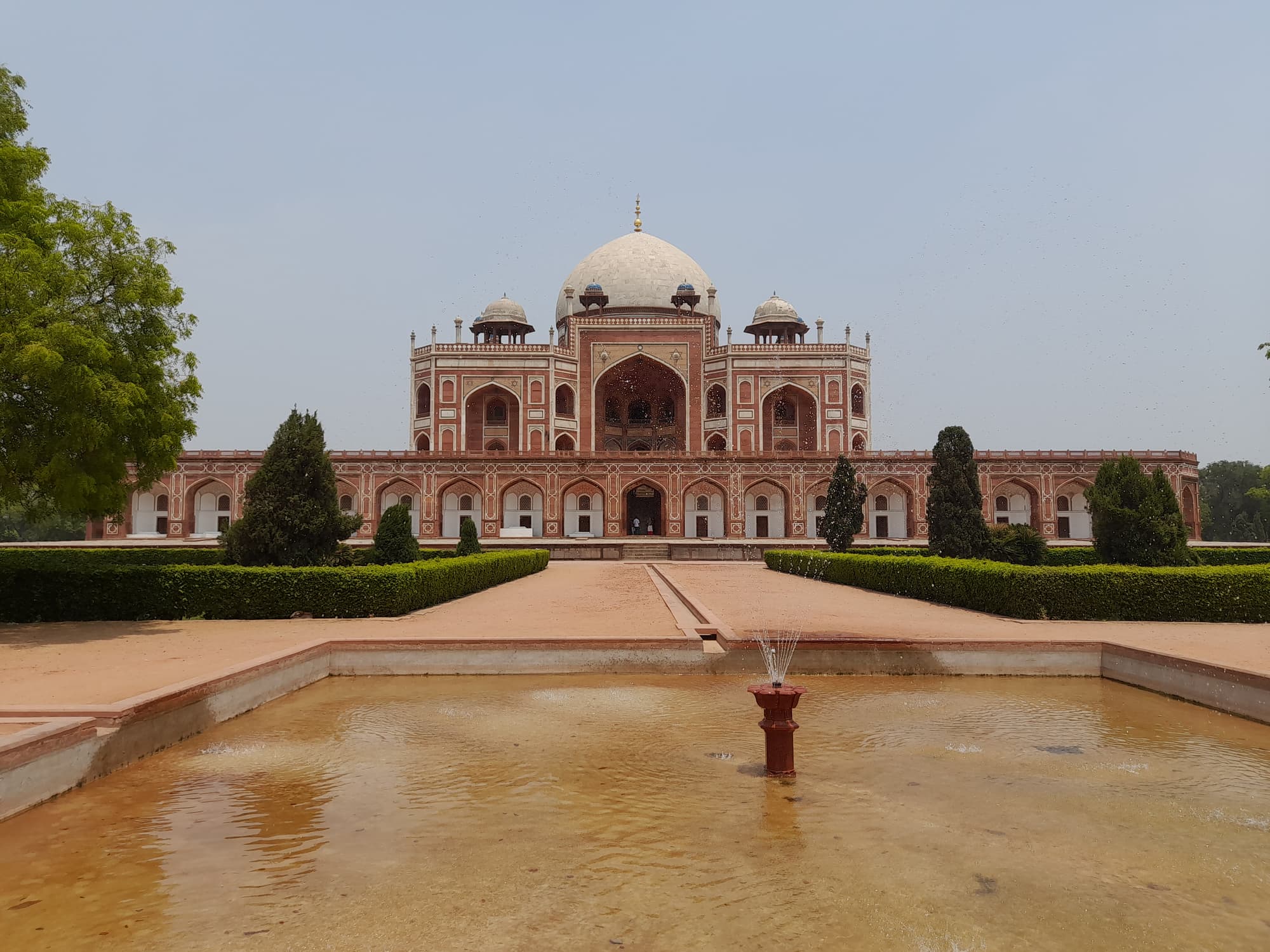
Humayun's Tomb
Delhi, Delhi
Historical MonumentsHumayun's tomb was built between 1565 and 1572 designed to be the mausoleum of the second Mughal Emperor, Humayun, who had died in 1556. It was commissioned by his grieving widow, Hamida Banu Begum. <br> The tomb includes over 150 graves of immediate members and descendents of Humayun's family as well as other nobles of the Mughal court. <br><br> It stands on a platform of 4000 sq. m and goes up to a height of 47m. The finial on the top is 6m high. It is one of the earliest examples of Persian influence in Indian architecture. Its design represents an amalgamation of styles that Humayun saw during his years in exile in Persia and Afghanistan. <br><br> The primary structure is a square structure with chamfered corners and arched gateways clad in red sandstone and marble. It is mounted on a large terraced platform about 10m high, topped by a large central dome, with two-bay deep vaulted cells on all four sides. The central hall has only one cenotaph - that of Humayun - with a marble tombstone devoid of any calligraphy, and simply decorated. The central hall mimics the overall plan of the tomb in plan - a square with chamfered corners. At each corner of this hall is an arched doorway that leads to a chamber which is again of similar plan - a square with chamfered edges - but smaller in size. These ancillary chambers contain the graves of immediate family members. <br> The central dome is clad in marble and stands on a circular red sandstone drum which is 8m high. This drum is adorned with star shaped pattern in yellow stone, with the center of these ornamentations filled with a black slate medallion. There are four secondary cupolas with domes on the terrace, complementing the primary dome. There are two minor chhatris on each of the major arches on each face of the mausoleum. There are 24 domed minarets along the parapet, slightly larger ones at each corner of the major arches, and smaller ones at the corners of the octagonal projections. <br> The cenotaphs are openly accessible, while the true graves are located one level below. It is the first of the garden-tombs in the Indian sub-continent, and inspired a number of other tombs, including the famous Taj Mahal. <br><br> The tomb stands in the middle of a rectangular garden of the traditional <i>char-bagh</i> design. The garden is divided into four sections by channels filled with flowing water, each of which is further sub-divided into nine sections. The four innermost sub-divisions form the platform on which the tomb stands. Flowing water was an essential element of the Mughal garden-tombs, and Humayun's tomb has underground terra-cotta pipes, aqueducts, fountains, and water channels to supply and carry the flowing water. <br><br> The tomb is located close to the shrine of the 14th century Sufi Saint, Hazrat Nizam-ud-din Auliya. The Humayun's tomb complex also includes several other structures, including Isa Khan's Tomb, Bu Halima's Tomb, Afsarwala Tomb and Mosque, Arab Sarai (stables), the Nila Gumbad, and Barber's tomb. The last Mughal Emperor, Bahadur Shah Zajar, took refuge at Humayun's tomb after he was ousted from Red Fort when the 1857 revolt was put down in Delhi. He was arrested by Captain Hodson and exiled to Rangoon.