
Nalanda University
Nalanda, Bihar
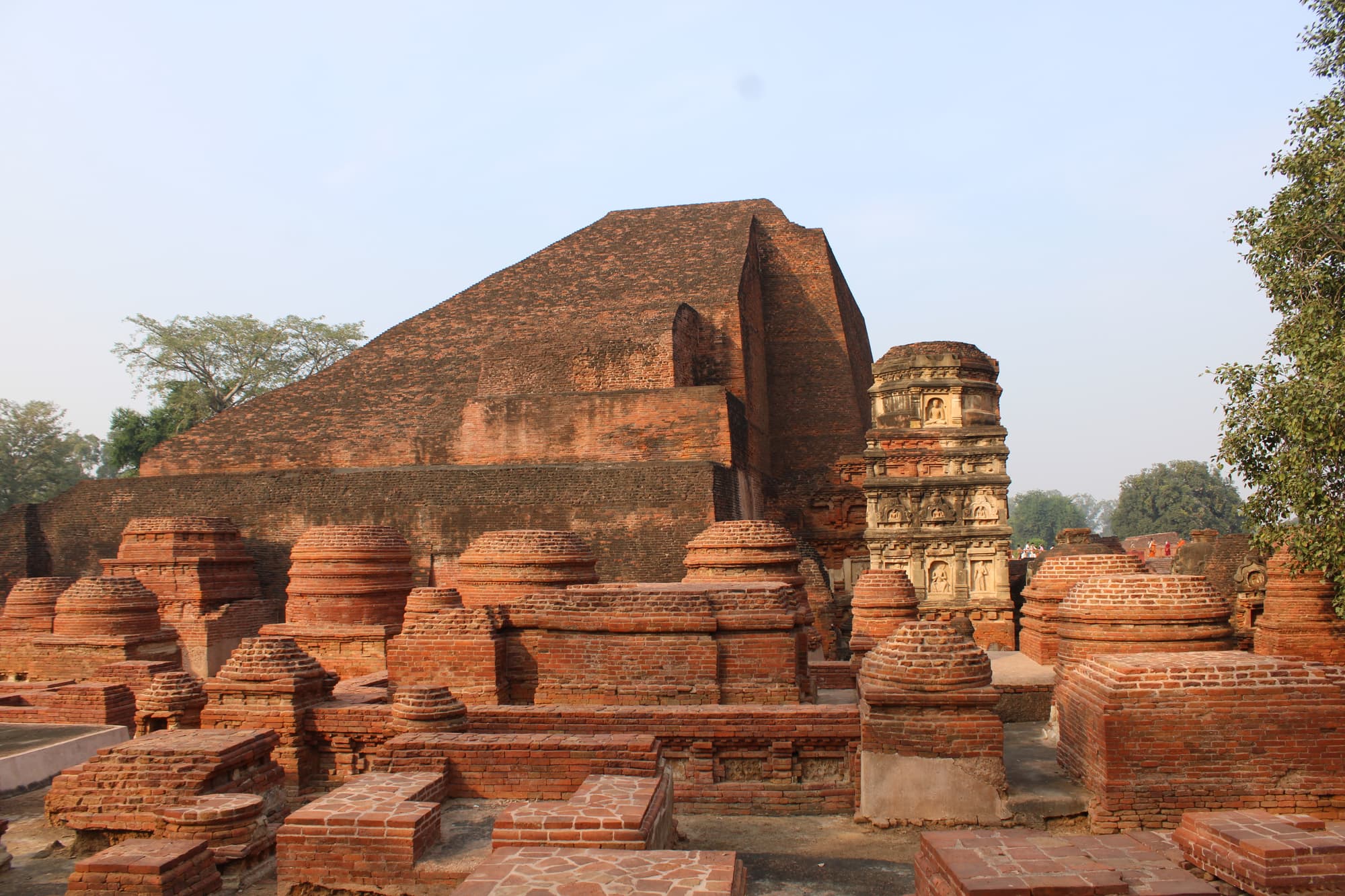
Historical MonumentsThe Nalanda Mahavihara was a respected and flourishing university which survived for nearly thousand years. Nalanda played a vital role in promoting arts and academics during the reign of the Gupta empire in 5th and 6th century CE, and was most likely founded during the reign of Kumargupta. <br><br> The excavated remains of the university cover an area 488m north to south, and 244m east to west. Excavations have revealed eleven monasteries or viharas and six major brick temples arranged in an ordered layout, flanking both sides of a 30m broad central boulevard which runs north to south. Temple No. 3, the most imposing structure at the site, stands at the southern end of this boulevard. <br><br> <b>Temple no. 3</b> (also termed Sariputta Stupa) is the most iconic of Nalanda's structures with its multiple flights of stairs that lead all the way to the top. The temple was originally a small structure which was built upon and enlarged by later constructions. The final structure is a result of at least seven phases of construction. The fifth of these is the best preserved with four corner towers of which three have been exposed. The towers as well as the sides of the stairs are decorated with panels of Gupta-era art depicting a variety of stucco figures including Buddha and the Bodhisattvas, and scenes from the Jataka tales. The temple is surrounded by numerous votive stupas some of which have been built with bricks inscribed with passages from sacred Buddhist texts. The apex of Temple no. 3 features a shrine chamber which now only contains the pedestal upon which an immense statue of Buddha must have once rested. <br> A cross-section of the temple reveals that the inside is partioned off into separate radial compartments by interior walls. <br> A large image of Avalotiteshvar was found in a shrine near the bottom of the staircase, and later moved to the museum. <br><br> <b>Temple No. 12</b> is an east-facing temple built on a square base of about 50m side. It had a central shrine, with four subsidiary shrines at the four corners of the structure. It was constructed in at least two phases, with the first phase coresponding to the fifth phase of Temple No. 3 in terms of vintage. The exterior walls of the temple dating back to the first phase feature pilasters, ornamental mouldings, and niches for containing stucco idols, whereas the latter phase walls are mostly plain. <br><br> <b>Temple no. 14.</b> is the northernmost of the temples excavated at the site. An enormous image of the Buddha was discovered here. The image's pedestal features fragments of the only surviving exhibit of mural painting at Nalanda. <br><br> The <b>monasteries</b> at Nalanda are very similar in layout and general appearance, and not unlike hostels at many modern day colleges in India. The hostels have a rectangular form with a central quadrangular court which is surrounded by a verandah which, in turn, is bounded by an outer row of cells for the monks – a typical design of vihara architecture. The central cell facing the entrance leading into the court is a shrine chamber. The monasteries all face west with drains emptying out in the east and staircases positioned in the south-west corner of the buildings, with the exception of the two monasteries at the southern end of the boulevard. <br><br> <b>Monastery 1</b>, at the southern end of the boulevard, shows as many as nine levels of construction. Its lower monastery is believed to be the one sponsored by Balaputradeva, the Srivijayan king, during the reign of Devapala in the 9th century. The building was originally at least 2 storeys high and contained a colossal statue of a seated Buddha. <br><br> The base of a Hindu temple, known as Temple No. 2, is found to the east of Monasteries 7 and 8. Its moulding is decorated on all four sides by carvings of gods, musicians, dancers, and fanciful animals. <br><br> The curriculum of Nalanda included major Buddhist philosophies, as well as other subjects like the Vedas, grammar, medicine, logic, mathematics, astronomy, and alchemy. The mahavihara had a renowned library that was a key source for the Sanskrit texts that were transmitted to East Asia by pilgrims like Xuanzang (Hieun Tsang) and Yijing.