
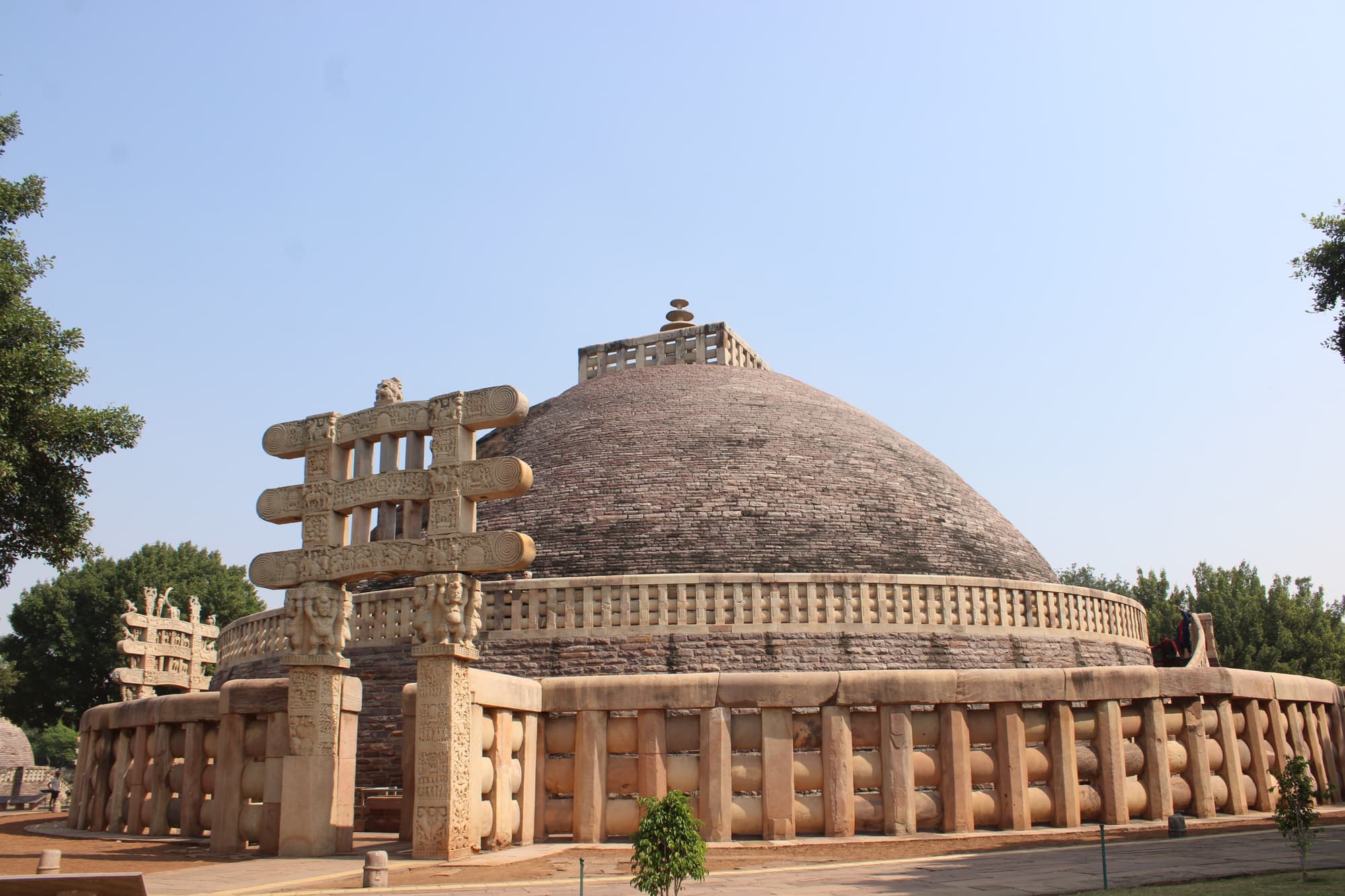
Sanchi Stupa
Sanchi, Madhya Pradesh
Place of Worship<p>A <em>stupa</em> is a Buddhist commemorative monument, usually in the form of a hemispherical solid dome, usually housing relics associated with the life of Gautam Buddha. The Sanchi Stupa, about 45 kilometers north-east of Bhopal, is one of the oldest and best-preserved stupas in India. Supposed to have been first erected in the 2nd century BCE, it was repaired and restored by several kings and rulers who patronized Buddhism (notably by the Satavahana kings who added the balustrade and the four elaborate gateways or <em>toranas</em>), while it fell into neglect and disrepair at other times. There are scores of stupas near Sanchi, from a few hundred meters away to ten to fifteen kilometers away.</p><p><strong>Stupa No. 1</strong> is the most famous example of the stupas at Sanchi. It stands on top of a small hillock a couple of kilometers from Sanchi Railway station. It consists of a plastered dome enclosed by a high stone railing, and crowned by a triple umbrella, standing within a square railing. It contains at its core, the brick stupa said to have been commissioned by Ashoka himself. The domic surface of the stupa is devoid of any ornamentation. A circum-ambulatory path is naturally formed between the high railing and the base of the hemispherical dome. A second circum-ambulatory path, approached by a double stairway on the south, runs around the dome about 2.5m above ground level.</p><p>The core brick stupa from Ashoka's reign was covered with an ashlar stone veneer, and augmented with circumambulatory paths and staircases with ornate balustrades, harmika, yashti, chhatra, and four torana during the Sunga dynasty (184-72 BCE). The four gateways were further ornamented during the Satavahanas dynasty in the 1st century CE. The last addition to the grand stupa was during the Gupta dynasty (5th century CE), when four shrines were added at the cardinal entry points.</p><p>The four elaborately decorated gateways (<em>torana</em>), one in each cardinal direction, provide access to the lower balustrade and the path within. There are four idols of Buddha in seated position just inside the gateway, one inside each gateway. The scenes depicted on the gateways are drawn from Jataka tales, the life of Gautam Buddh, and subjects connected with the Buddhist faith.</p><p>The depictions of Buddha at Sanchi are aniconic - with an elephant representing the birth of Buddha, a throne under a <em>bodhi</em> tree depicting his enlightenment, the <em>dharmachakra</em> flanked by deer representing his first sermon, and a riderless horse depicting his departure from the mortal world.</p><p>Following the Buddha's <em>parinirvana</em> (death), the Malla clan of Kushinagara initially refused to share the ashes with other kingdoms. To avoid war, the relics were divided into eight parts and distributed to various rulers, including Ajatashatru of Magadha and the Sakyas of Kapilavastu. The rear bottom architrave of the South Gate of Stupa 1, portrays the siege in relief, showing warriors on elephants and horses, with a, likely symbolic, war to claim the sacred relics. 200 years later, Emperor Ashoka reopened the eight original stupas to redistribute the relics into 84,000 smaller stupas.</p><p>Inscriptions on the gateways, pavements, and railings credit a large number of donations made by devotees from nearby Vidisha and other far-flung regions as well.</p><p>The dimater of Stupa No. 1 is 36.6m, and its height is 16.5m.</p><p><strong>Stupa No. 2</strong> is much smaller than Stupa No. 1 but includes a a ground balustrade with four entrances along the cardinal axes, just as in the case of Stupa No. 1. It does not have an umbrella structure on the top, because of which the top of the dome appears to be truncated. There are no gateways either. It stands about 350m northwest of Stupa No. 1</p><p><strong>Stupa No. 3</strong> resembles Stupa No. 2 in shape and size and has one gateway on the south, similar to the gateways of Stupa No. 1, as well as a double-stairway on the south leading up to a circum-ambulatory platform mid-way through the height of the stupa. It has a single <em>chhatri</em> on top, enclosed within a square railing.</p><p>There are several other structures in the complex, some of which can be dated to later periods such as the Gupta period showing that the site was in continued use for centuries. </p><p><strong>Temple No. 17</strong> consists of a flat-roofed square sanctum, and a portico supported on four pillars. It is remarkable for its symmetrical proportions.</p><p><strong>Temple No. 18</strong> is from the 7th century CE, and has an apsidal shrine with a central nave and side aisles. It stands on the foundations of an earlier hall dating back to either the Maurya period or the Sunga period. The tapering pillars of the temple have slightly ornamented capital blocks. A restoration of the temple in the 10th or 11th century CE added the richly carved door jambs.</p><p><strong>Monastery 51</strong> is a well-preserved quadrangular structure with stone walls veneered with bricks.</p>