
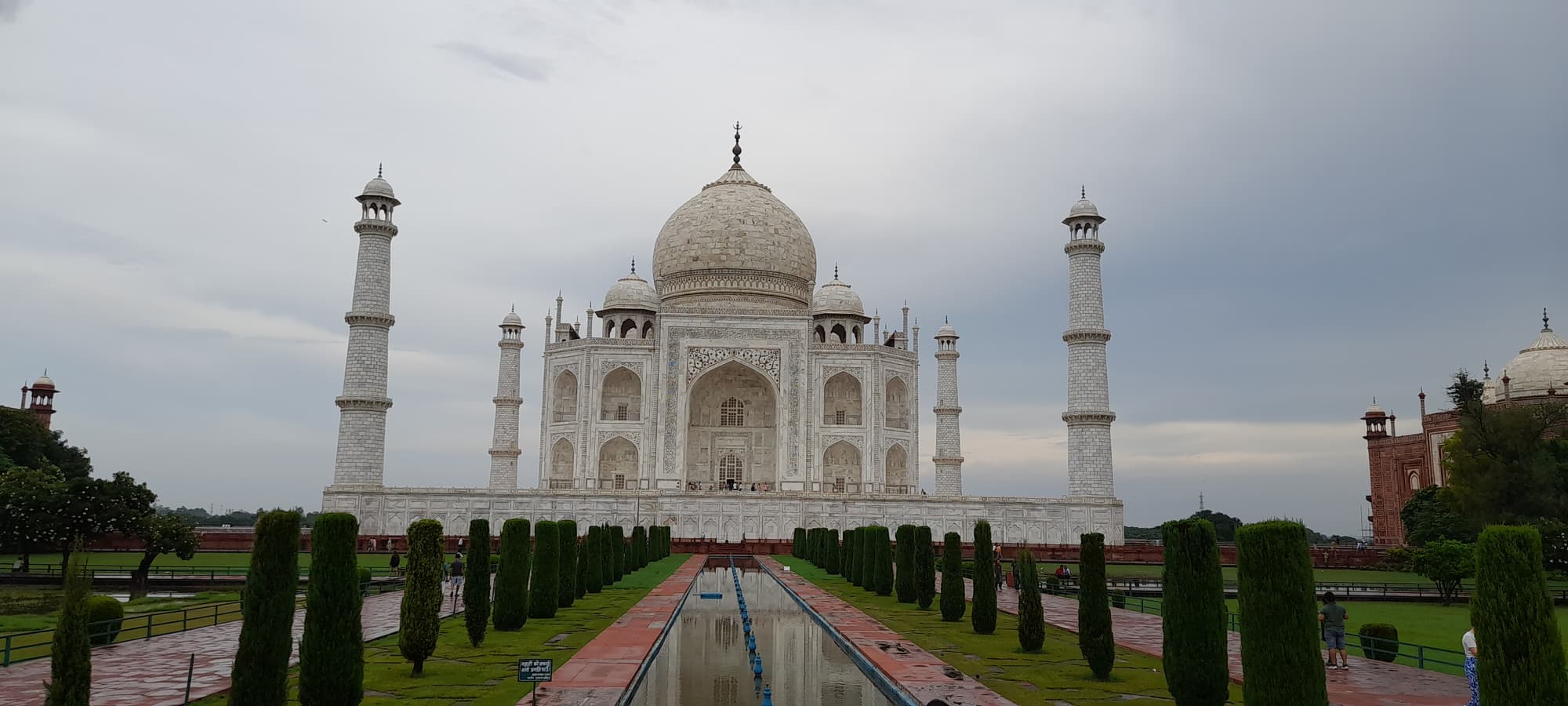
Taj Mahal
Agra, Uttar Pradesh
Historical Monuments<p>Built in the 17th century by the Mughal emperor Shah Jahan in memory of his wife Mumtaz Mahal, the Taj is not just a symbol of love but also of exquisite craftsmanship. It stands on the right bank of the river Yamuna, on the northern end of a well proportioned garden.</p><p>The symmetry of the Taj Mahal is one of its hallmarks, with each of its four facades being identical. The key to its enduring beauty is restraint, proportion, symmetry, and the contrast between large smooth surfaces and fine, delicate detailing. The architecture is a blend of Persian, Islamic, and Indian styles. The large central dome, the four slender minarets, and the intricate calligraphy around the entrances all contribute to a sense of harmony and balance.</p><p>It stands on a a wide raised marble platform. Centered on the platform is a large square structure with slightly chamfered corners. A massive onion-shaped dome stands on top of and in the center of this central block, rising smoothly, almost like a swelling curve, and then tapering inward slightly before ending in a pointed finial. The dome sits on a short cylindrical drum, giving it height and prominence. There are four smaller domed pavilions around the main dome, add - one at each corner of the roof. These are much smaller but echo the same onion-shape dome.</p><p>A large central arch dominates each façade. This central arch is tall and pointed, with a smooth, recessed interior. On either side of this main arch, stand two smaller arches stacked vertically, maintaining perfect symmetry. The main arch is framed with a rectangular border that emphasizes its height. Calligraphy bands run along the edges within this frame, containing verses from the Quran. The calligraphy deliberately increases in scale as it rises higher, making it appear uniform in size.</p><p>The marble surfaces are covered with delicate inlay work made with semi-precious stones forming floral patterns. This technique, known as pietra dura, is one of the monument’s defining artistic features. Unfortunately, much of the original decorative elements have been lost to vandals.</p><p>Four tall and slender minarets stand at each of the four corners of the platform.Each minaret is divided into three sections by horizontal balcony rings. At the top of each minaret is a small domed canopy. The minarets tilt outwards at 4° creating a visual impression of being vertical and also serving a purpose of insuring the main mausoleum in case of structural collapse. Each minaret is cylindrical, but it isn’t a completely smooth, uninterrupted curve. The surface is divided into a series of vertical sections by very shallow, almost flat projections arranged evenly around the shaft.</p><p>At the heart of the main chamber are the cenotaphs of Mumtaz Mahal and Shah Jahan. These are false tombs — ornate, elevated marble structures. Mumtaz Mahal’s cenotaph is positioned at the exact center of the chamber, while Shah Jahan’s was added later beside it, slightly offset, which is the only break in the otherwise perfect symmetry of the entire complex. The cenotaphs are richly decorated with intricate pietra dura inlay and inscribed with calligraphy.</p><p>Surrounding the cenotaphs is a marble screen, or <em>jali</em>. This is a finely carved octagonal enclosure made from a single type of white marble, though assembled from multiple panels. The carving is delicate, almost lace-like, with repeating geometric and floral patterns pierced through the stone. It serves as a boundary while still allowing light and air to pass through.</p><p>Beneath this chamber, in a simpler and more austere lower level, lies the actual crypt. Here are the real graves of Mumtaz Mahal and Shah Jahan. Unlike the cenotaphs above, these are plain and minimally decorated, following Islamic traditions.</p><p>A long reflecting pool has been created in the forecourt, aligned exactly with the center of the monument reflecting the dome and central arch clearly.</p><p>To the west of the Taj stands a mosque made of red sandstone. It has a long rectangular form with three large domes on top, smaller than the main dome but echoing its shape. The front façade features a series of arches, with the central arch larger and more prominent. Inside, the floor is marked with prayer spaces, aligned toward Mecca.</p><p>On the eastern side is an almost identical structure often called the jawab (meaning “answer”). It mirrors the mosque in shape and size, maintaining perfect visual symmetry across the central axis. However, its interior is simpler and lacks the prayer markings found in the mosque.</p><p>At the southern end of the complex lies the grand entrance gateway. This is a monumental red sandstone structure with white marble accents. It acts as a transition space between the outside world and the serene garden. The gateway has a large central arch, flanked by smaller arches, and is topped with decorative domed pavilions. The arch provides a perfectly framed view of the Taj Mahal itself, making for a deliberate, photographic reveal.</p><p>The gardens themselves are an essential part of the design. Laid out in a charbagh (four-part) pattern, they are divided by walkways and water channels into symmetrical sections. The long reflecting pool along the central axis is particularly important—it visually doubles the monument and reinforces the theme of harmony.</p><p>Finally, along the riverfront side, there are terraces and boundary walls that connect the complex to the Yamuna River. This edge was once an active part of the experience, with views and access from the water.</p><p>Together, these elements create not just a single building, but a complete architectural composition where every structure supports the whole.</p>