
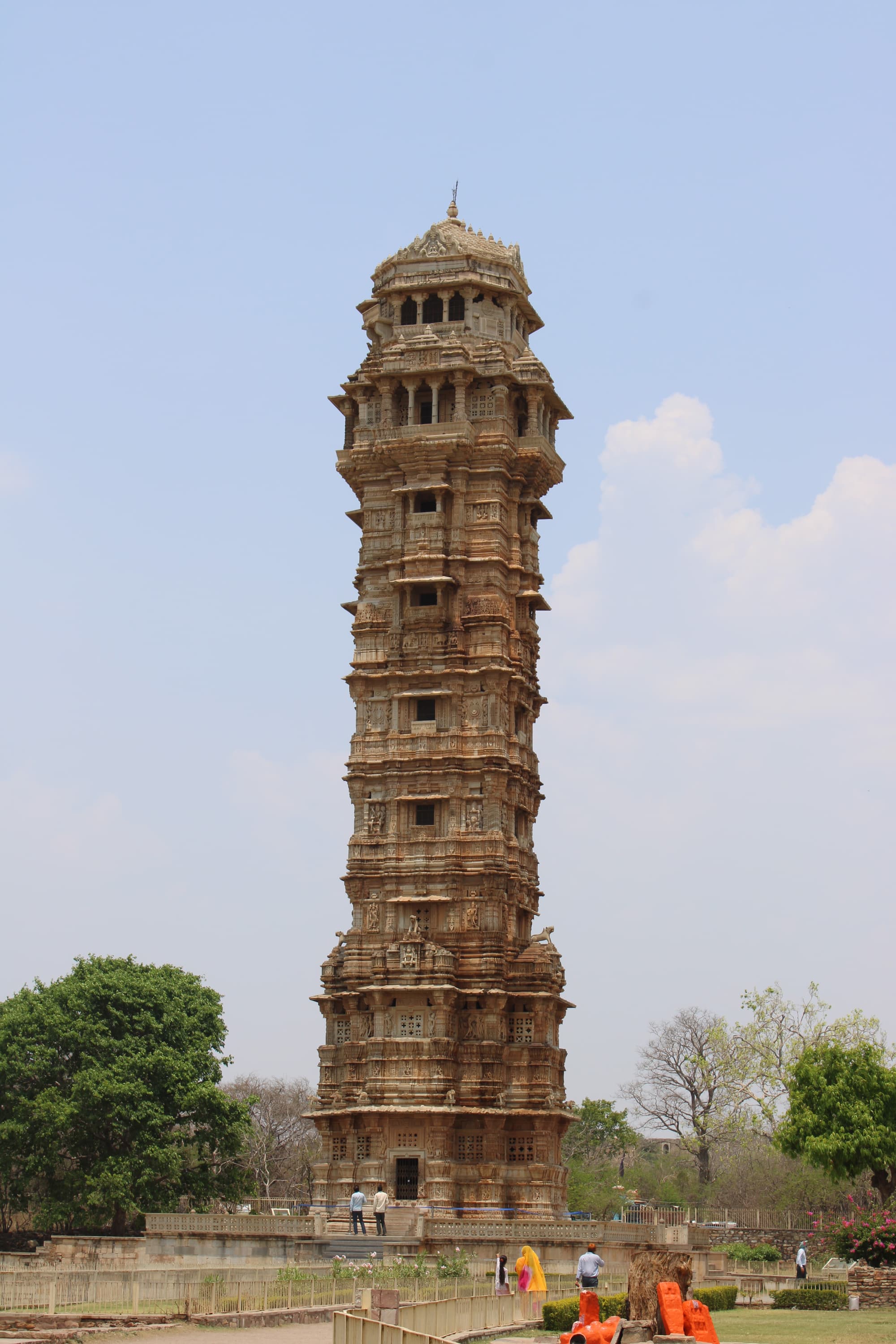
Victory Tower
Chittor, Rajasthan
Historical Monuments<p>The Vijaya Stambh or Victory Tower is an imposing tower constructed by the Rajput king, Rana Kumbha of Mewar in 1448 CE, to commemorate his victory over the army of Malwa led by Mahmud Khalji in the Battle of Sarangpur.</p><p>The tower is dedicated to the Hindu God Vishnu. The tower is made of sandstone and white marble, and has a balcony on each of its 9 floors.</p><p>It stands inside an open stone courtyard within Chittorgarh Fort. The structure is a tall, narrow tower built from warm yellow-beige sandstone and white marble with slightly weathered surfaces. It rises nine stories high, tapering subtly as it ascends. The penultimate floor is slightly larger than the one immediately below it, thanks to the projecting balconies, The overall silhouette is rectangular and vertically segmented, with sharply defined edges and dense surface carvings covering nearly every visible face.</p><p>The base platform is square and elevated by a few broad stone steps. Around the base are low stone parapets and scattered temple fragments and smaller shrines made from the same pale sandstone.</p><p>The tower itself is divided into stacked horizontal tiers separated by projecting stone cornices. Each level has balconies with awnings that protrude outward on all four sides. The balconies are supported by heavy carved stone brackets shaped like layered geometric forms and stylized floral motifs. The balcony railings are composed of perforated stone screens and miniature columns. The profile of the first, second, and eighth floors overlays a cross over the central square, creating projecting balconies on all four sides. At the top is a domed pavilion canopy supported by slender carved pillars.The top floor has chamfered edges, giving it an octagonal profile. Above the dome rises a <em>kalasha</em> crowning the tower. The roof edges project outward slightly, casting narrow shadows below them.</p><p>The interior and exterior of the tower feature intricate carvings showing Hindu deities (Ganesha, Vishnu, Lakshmi, Shiva, , inscriptions, images of weapons, musical instruments, warriors, floral scrollwork, geometric bands, arches, and niches, and vegetal patterns. Human figures appear in vertical panels, standing largely in frontal poses with elaborate headdresses and jewelry. Between the sculptural panels are narrow vertical pilasters running from one level to the next. Elephants and Lions stand as guardian sentinels atop the second and third floors.</p><p>The windows are small, recessed openings framed by ornamental arches. Some openings are deeply shadowed, creating strong contrast against the sunlit stone. The carvings become finer and more compact toward the upper stories.</p><p>The inscribed slabs of the uppermost floor contain genealogy of the rulers of Chittor from Hamir to Rana Kumbha. The names of the architect, Sutradhar Jaita and his three sons who assisted him, Napa, Puja, and Poma, are carved on the fifth floor of the tower.</p><p>The tower is located in the Chittor fort which is spread over 700 acres. The fort stands on top of the long and narrow ridge of a hill overlooking Chittor town in Rajasthan, India, and is located on the banks of the river Gambhiri. The fort walls have a circumference of about 13km. <br><br>The access to the fort is through a path that winds its way up the hill, crossing seven gates. These gates are named after the small shrine situated closest to the gate - Padan Pol, Bhairon Pol, Hanuman Pol, Jodala Pol, Ganesh Pol (the Ganesh Pol is the one in the poorest condition and is largely ruined), the Laxman Pol, and the best preserved and most beautiful of all, the Ram Pol.</p><p>There are a number of other structures located within the Chittorgarh fort.</p><p>The <strong>Kumbhaswamin Temple</strong> was originally dedicated to Varaha, an incarnation of Vishnu. It was renovated during the reign of Maharaja Kumbha (1433-68). It stands a quarter of a mile to the north of the Vijay Stambh. It stands on a high plinth, and comprises of a sanctum, a <em>mandapa</em> (forecourt), and an open <em>pradakshina path</em> (circumambulatory). The plinth features a number of deities carved into verical niches separated by geometrical patterns.The sanctum shows bold podium mouldings decorated with sculptured niches on the projections. The roof of the mandapa is pyramidal in form, while the sanctum is crowned by a tall <em>shikhara</em> or spire. The interior of the mandapa has twenty elaborately carved pillars. An image of varaha occupies the central niche on the back of the shrine, while there is a canopied structure with four pillars in front of the temple, housing an image of Garuda, Vishnu's mount.</p><p>A little to the south of the Kumbhaswamin temple is a smaller shrine known as the <strong>Meera Mandir</strong>, which features an idol of Krishna on a raised platform in the sanctum. A four-pillared <em>chhatri</em> built in the memory of Meera's guru stands in front of the temple. There is an image of five human bodies with one shared head carved into the ceiling of this chhatri.</p><p>The <strong>Samadhiswara Temple</strong> stands a short distance to the south-west of Vijay Stambh. It is dedicated to Shiva, and was built by Raja Bhoja Parmara in the middle of the 11th century. It was renovated by Mokal in 1428. It consists of a <em>grabha griha</em> or sanctum, an <em>antarala</em> (foyer), and three porticos on the north, south, and west. A colossal image of Shiva in his Trimurthi form is enshrined in the sanctum. The interior and exterior of the temple are elaborately carved with figures of Gods and Goddesses, along with floral, faunal, and geometric patterns. The ceilings are also decorated with geometric patterns carved into the stone. The Western portico houses an image of Nandi, the bull.</p><p>A large gateway stands on the east of the Samadhisvara temple. This double-storeyed structure has a central gateway which rises two storeys high, flanked by apartments on either side. There are faux windows with balconies and corbels on the upper floor of the structure, while the lower floor features images of gods and demi-gods placed in niches. <br>A long staricase to the south of the Samadhiswara Temple leads down to the mountain spring which is known as the Gaumukh kund.</p><p>The <strong>Padmini Palace</strong> stands about one km to the south of the Vijay Stambh. The palace stands on the northern shore of the Padmini Lake. There is a three-storeyed structure with arched opening that stands in the middle of the lake, known locally as the "Jal Mahal". <br>The main gate of the palace faces sest. This gate leads into a courtyard which has a number of small apartments on the south. Moving eastwards, there is a second courtyard which features a double-storeyed apartment with a view of the lake on the south. A rectangular courtyard further to the east features a circular pavilion on the south overlooking the lake.</p><p>The <strong>Kirti Stambh</strong> or Tower of Repute overlooks the eastern wall of the fort. The 24.5 metres high tower stands on a square foundation. It is dedicated to Adinatha, the first Jain tirthankara, and was built by a Jain merchant, Jeeja Bhagerwala around 1301 AD. A 12-pillared open pavilion is on top of the tower. It stands in the courtyard of the Saat-Bees Jain temple. The six storey structure is adorned by sculpture and mouldings from the base to summit. The carvings on each level are different from those on the others. The lower floors have carvings depicting the life of four Jain Tirthankaras, while the upper floors have secular, floral, and faunal decorative elements.</p>